Jaisalmer – maybe and a ghost town!

Jaisalmer

To safeguard the fort at Jaisalmer, places to stay are few and as much as the romanticism is appealing we stayed in a hotel outside the walls. I think comfortably, because I remember nothing about the first night there. We threw a spanner in the works of Magan Singh by saying that we wanted to go on a camel safari but bless him, a couple of calls and it was planned, so we stowed our bags at reception and set off for an overnight adventure fuelled by masala omelette, coffee and lassi. By nine we were pedal-boating around Gadisar Lake.

In India a lake is quite often a tank, a masonry lined reservoir for irrigation, and Gadisar is one of the most beautiful. The lake was full of fish, a bit like sterlets, large catfish and in the centre an island inhabited by cranes, herons and cormorants.

At points around the edge there were shrines and little summerhouses built for wives and courtesans of princes past. We spent an hour there and never have we been so thankful for our dupattas. We would have had sunstroke without them as the sun boiled us like potatoes in the water.

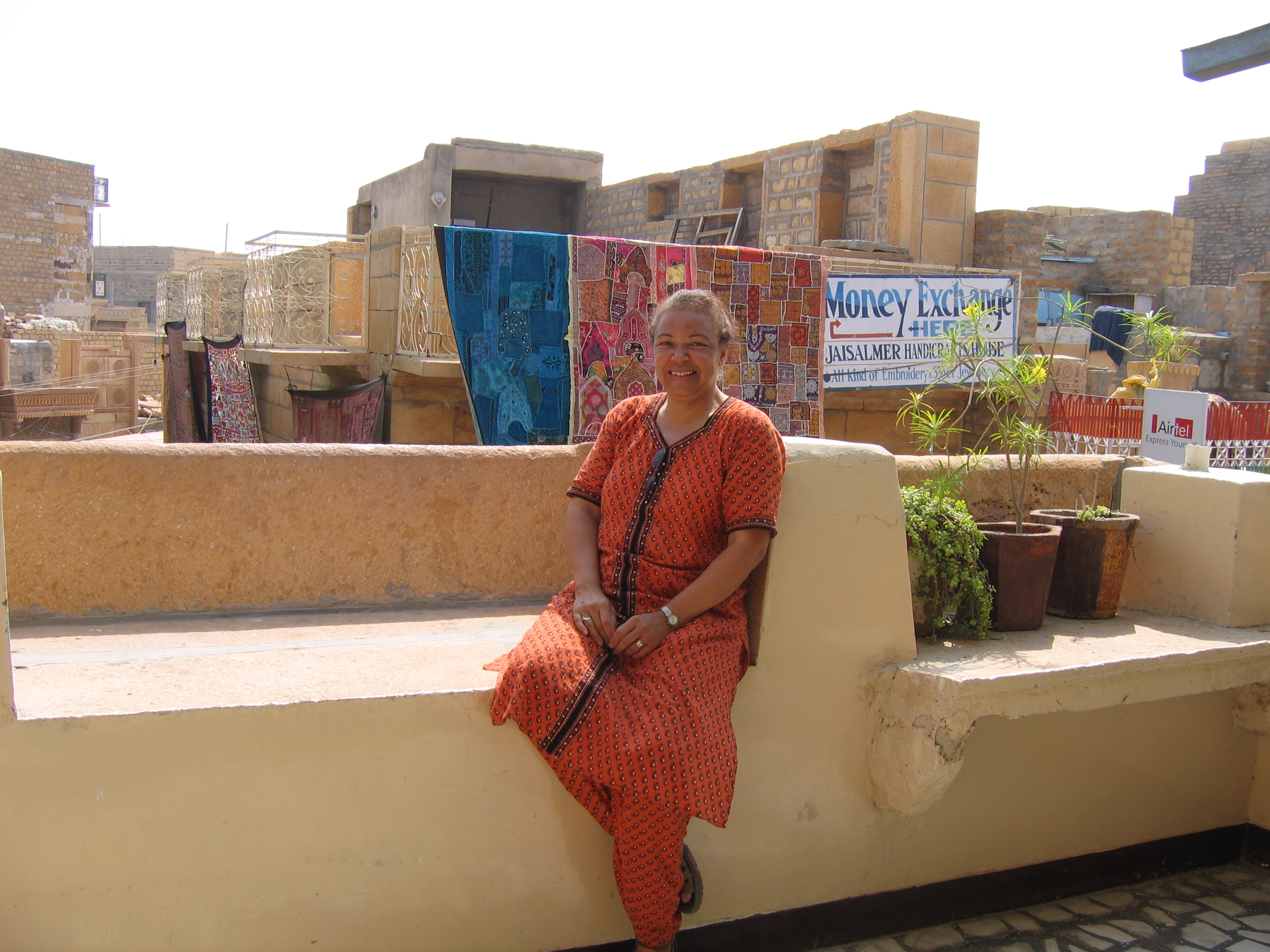
In town we had one of the few problems of the trip – we had been advised to take travellers cheques – a mistake! We went to cash some and  the first bank told us they didn’t do travellers cheques, so we went to the Bank of Jaisalmer and Bikaner, with a really grumpy cashier, where we were told to go to the Bank of Baroda, the first one! This was probably what had given Jaisalmer a reputation of not always being welcoming to travellers. Magan to the rescue, with a bureau de change that had a good rate and free bottled water. A ten year old boy charming a cobra from a basket blocked our way; do they have their nasty stuff milked? But it was worth battling past to reach Natraj, a rooftop restaurant beneath the fort where lunch and lassi (yes I was addicted and I’ll leave it to you to wonder if it was Bang lassi) for 200 rupees.
Off to the desert, so this sand-as-far-as you- can-see sauna is not desert? stopping on the way at an ancient deserted village, Khuldera, where 400 years ago the entire population upped sticks overnight, never to return again. The legend says that a dignitary from Jaisalmer coveted a young girl, the jewel of the village, and wanted to whisk her away to his harem. They thwarted his plans by leaving. Khuldera was in quite good condition, with well built homes and temples, as silent as the grave and you could just imagine them, camels laden and disappearing into the night.

I still haven’t told you very much about Jaisalmer, but you will have to wait until after the camel safari.

Across the Thar, Bikaner to the ends of the earth with prickles in my salwar kameez.

Until I began researching the idea of a trip to India I didn’t know Jaisalmer existed, but once I did it had the most powerful allure. I have tales to tell about the places en route out of Delhi, but that’s for later. We left Bikaner early, to travel 200 miles across the great Thar desert, a place so hot it burns inside your nostrils when you take a breath. After some 15 miles on NH15, signs of life became scarce. We stopped for a stretch and a photo opportunity, and when the engine was cut we stepped out into the most complete silence I’ve never heard. The landscape was empty, vegetation was the odd scrap of scrubby weed, with an occasional bug burrowing around it. It was my first taste of really dry heat – the closest feeling I can compare it to is a hair dryer on dry hair, and yet I loved it. It makes little sense to be able to get so much from . . . nothing, but I could have stayed at looked at that nothing for hours.

The good Mr Singh had other ideas, and rounded up travelling friend and I into our jeepy thing, where our body temperature gradually normalised. Half way across the desert the little huts started to appear occasionally, with boys persuading a goat or two with sticks. A government restaurant was our lunch venue with an indifferent Thali – because it contained the dreaded gobi – and apple juice, for one hundred rupees. More desert road, and just as our eyes were growing heavy, looking at beige-gold sand, Magan slowed down to negotiate his way through a crowd of people. There was nowhere, no homes, enclosed land, McDonalds or anything, but somehow around twenty people had appeared, to argue over who had run over, and killed, a camel. Someone had to compensate the owner and somehow it had to be moved. It was macabre, just like hearing sirens on the motorway.

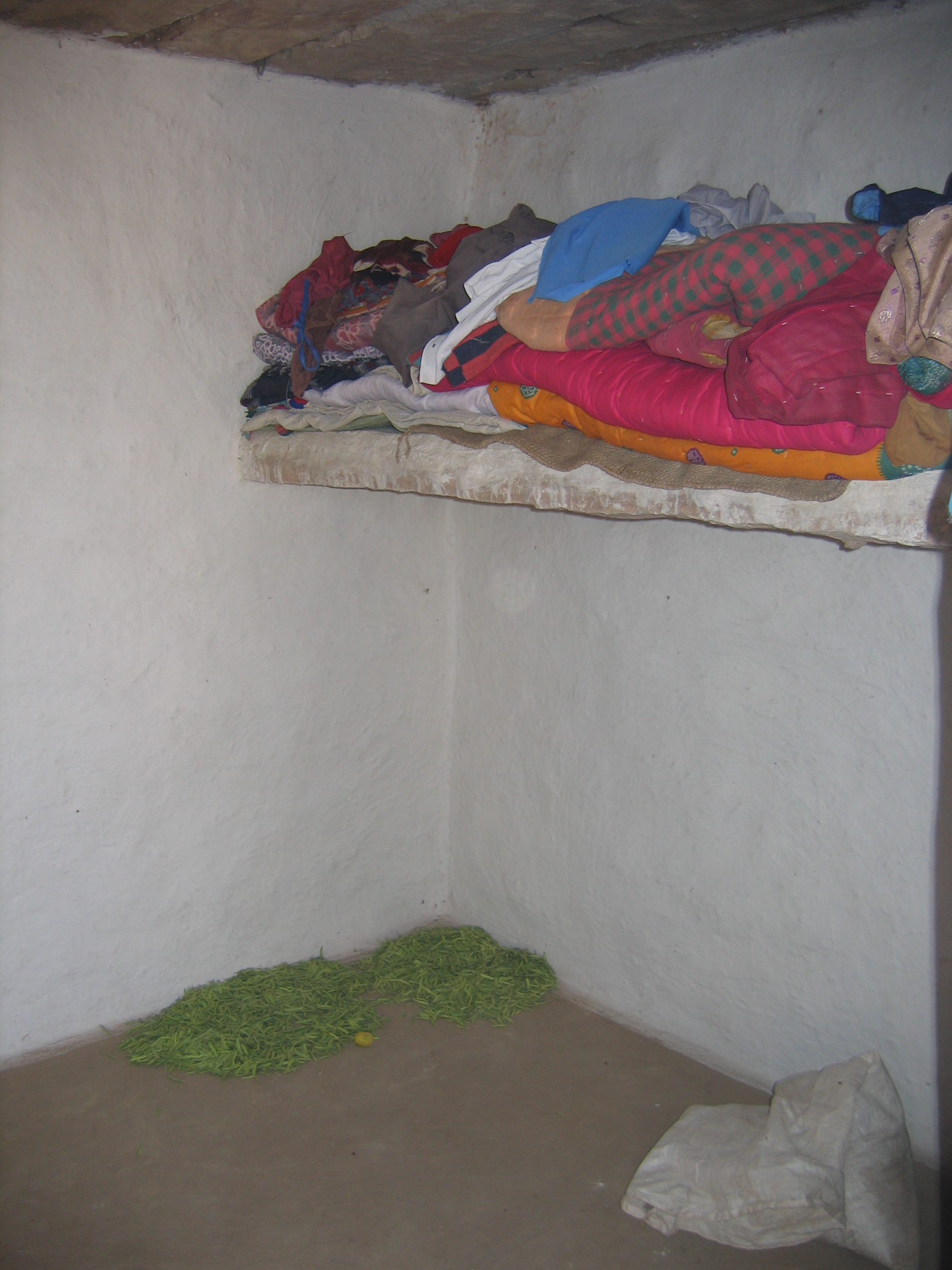
Magan must have watched our expressions in his mirror instead of watching the road, either that or he read our minds, because he always stopped just when we spotted something interesting. Later in the journey we became cynical, thinking that he had stopped at the very same place countless times, where the very same group of women always wore their best saris, for the delight of his western tourists. This time we had chosen a couple of striking brick and thatch houses a hundred yards from the road. As we took pictures some children came and invited us to visit their homes. Newly built and tiny but with a bed for each person, some shelves for clothes and one had a fire to cook.

Outside, another charpoy bed was under an open sided, four post shelter. In all there were three adults and seven children, the sum of their possessions would have fit under my kitchen sink but they were so happy and proud.

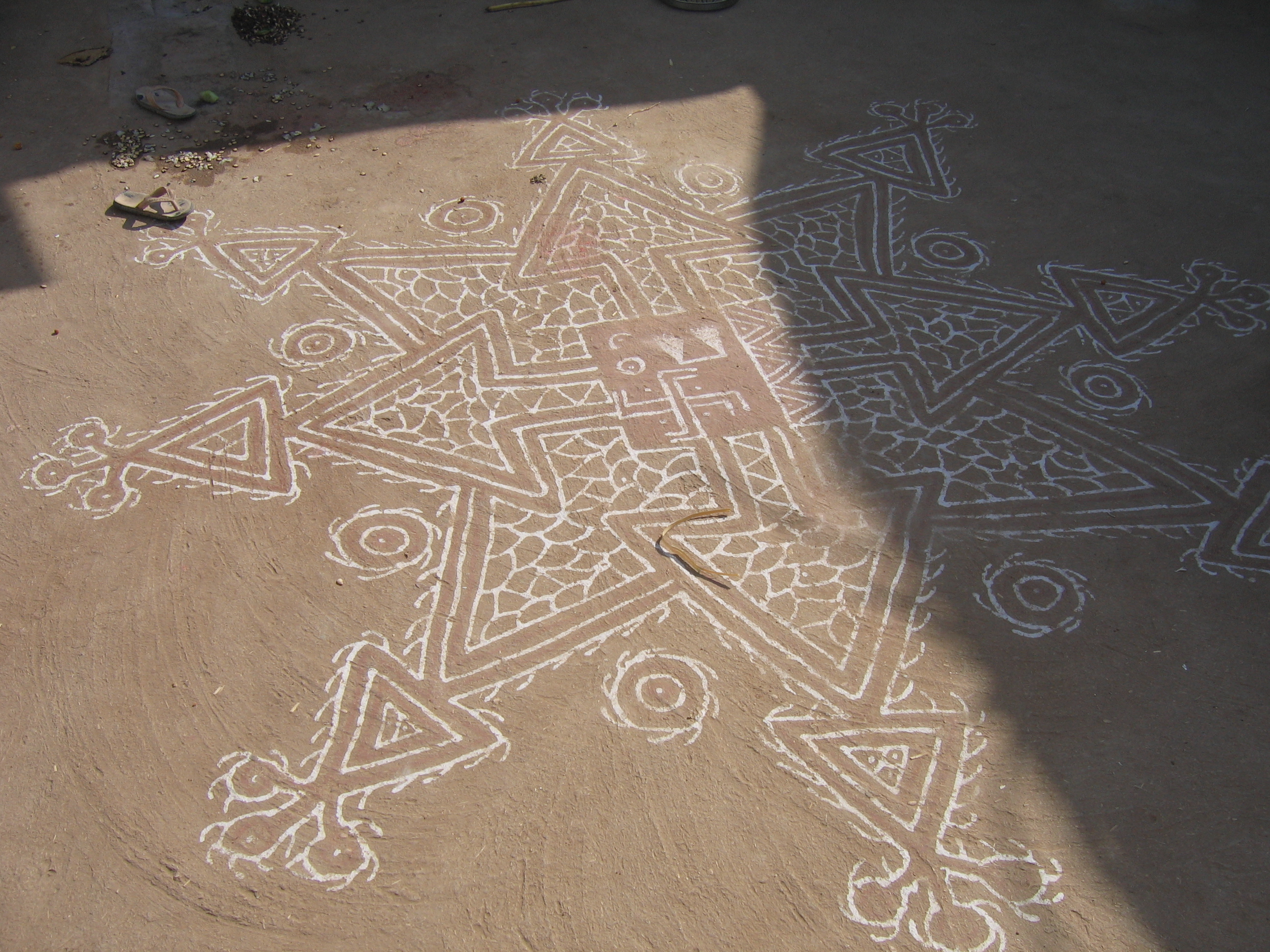
To celebrate Dussehra they had painted a Rangoli, a bit like a mandala, in white on the pressed ground that was their courtyard. The oldest child, a girl around twelve asked for shampoo but as Magan said we should not start a precedent, we gave them only sweets and they were very happy.  He told us that they would tell the story of our visit for the rest of their lives, we would never forget them either, it was an encounter to cherish.

The countryside from then on was sprinkled with villages and a few military bases, including an area where nuclear testing was carried out in the past. In the greener areas there were castor oil plants and kedgeree trees. We knew were approaching civilisation when there was enough irrigation from ‘tanks’, concrete reservoirs, to grow water melons. Rather than the red we are accustomed to, these were white fleshed and Magan smashed them against rocks for us, a welcome treat.

Magan had a wealth of knowledge to impart including about turbans:-

Men wear them to protect against heat.

They can be used as a towel

They can be tied to trees to use as a hammock.

They can be used as a bag.

And, different colours represent different families.

Our last stop before Jaisalmer was when we saw some women working in a field, Magan thought we wanted to take more photos, but before he noticed, I started to stride across to talk to them. I’d gone a little way when I heard him call me so I turned to wave and carried on. He called louder and sounded quite panicky, but because he was such a mother hen worrying about his Western chicks, I ignored him. He ran after me and looking like he was going to cry, pointed at the bottom of my salwar kameez. I was covered in hideous, prickly, seed heads that had buried themselves into the fabric and were agony to remove. He was mortified, poor man.

We arrived at a point just outside Jaisalmer, an ancient city at the end of the earth and stood to absorb the view. But you’ll have to come back again to hear more.


Weekly Photo Challenge: Faces

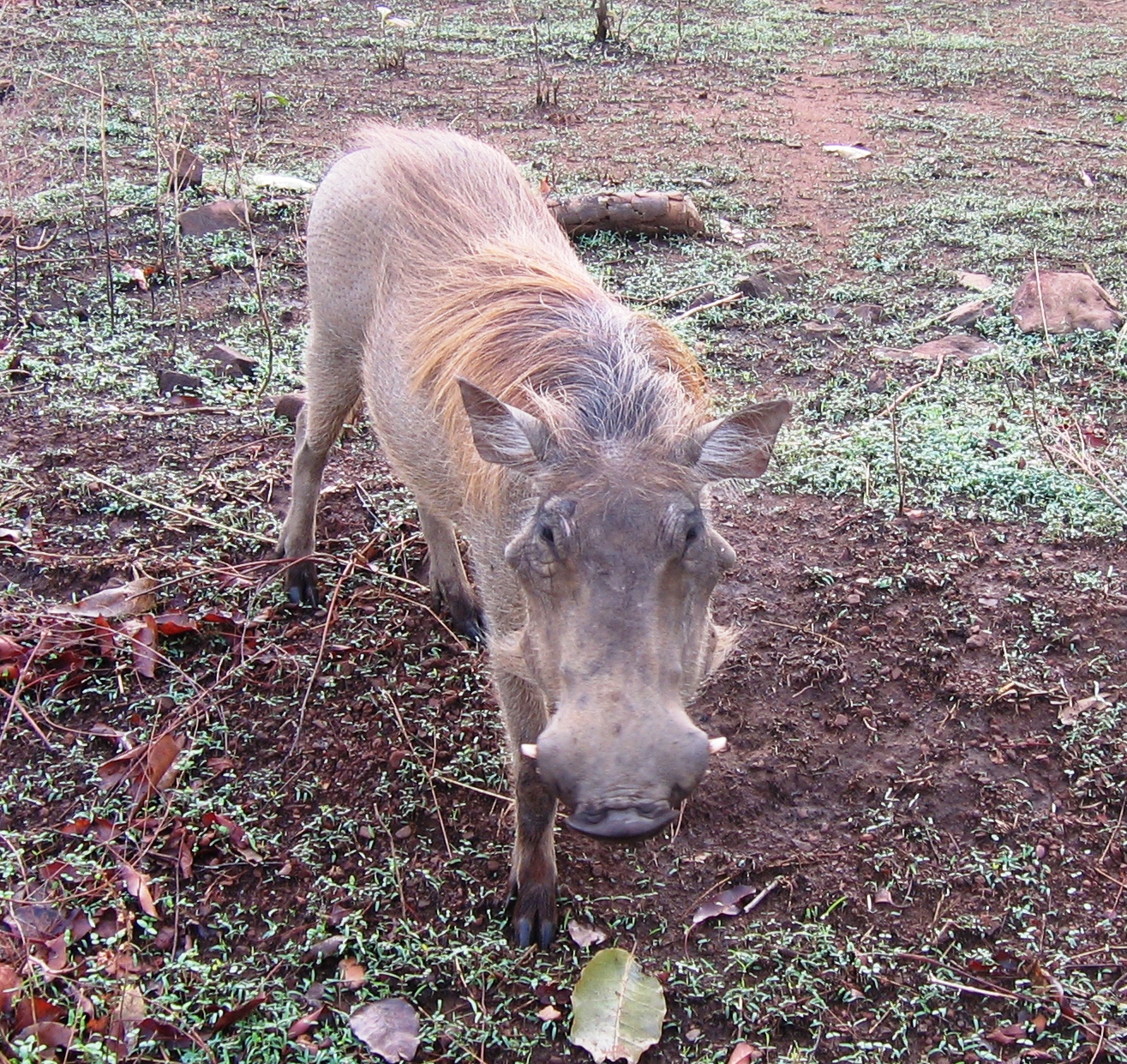
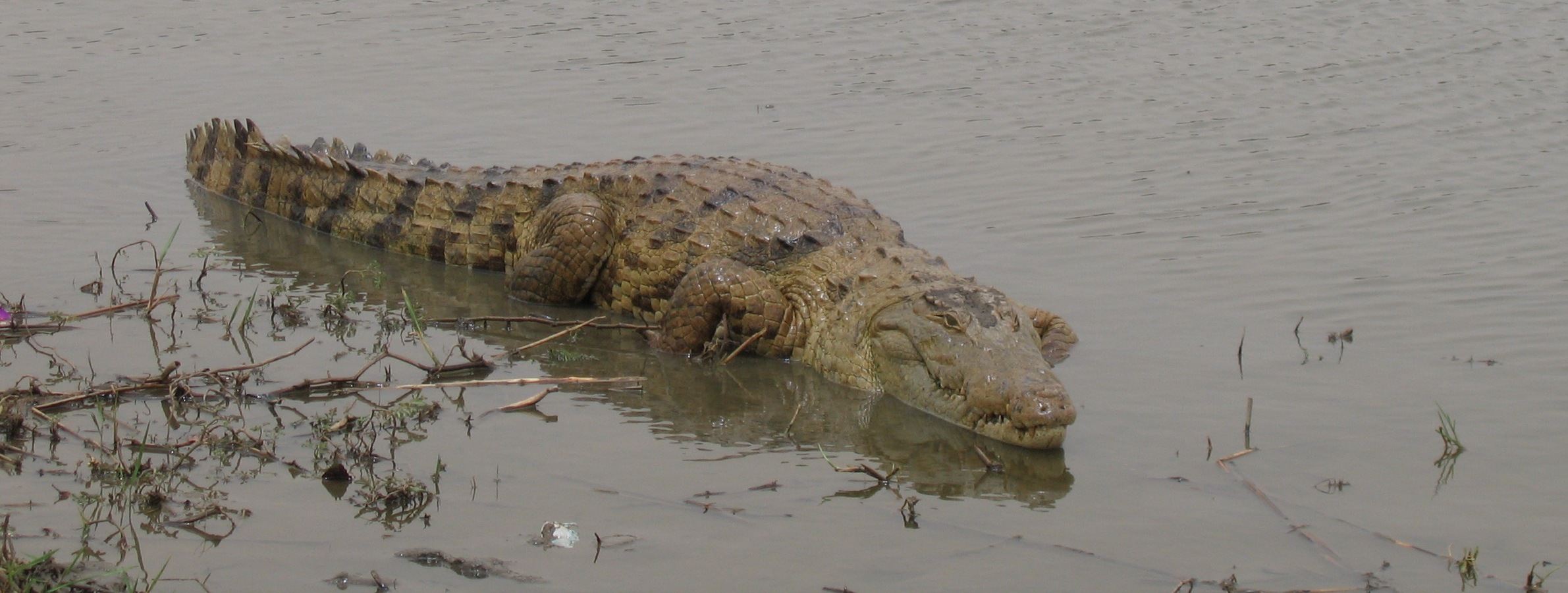
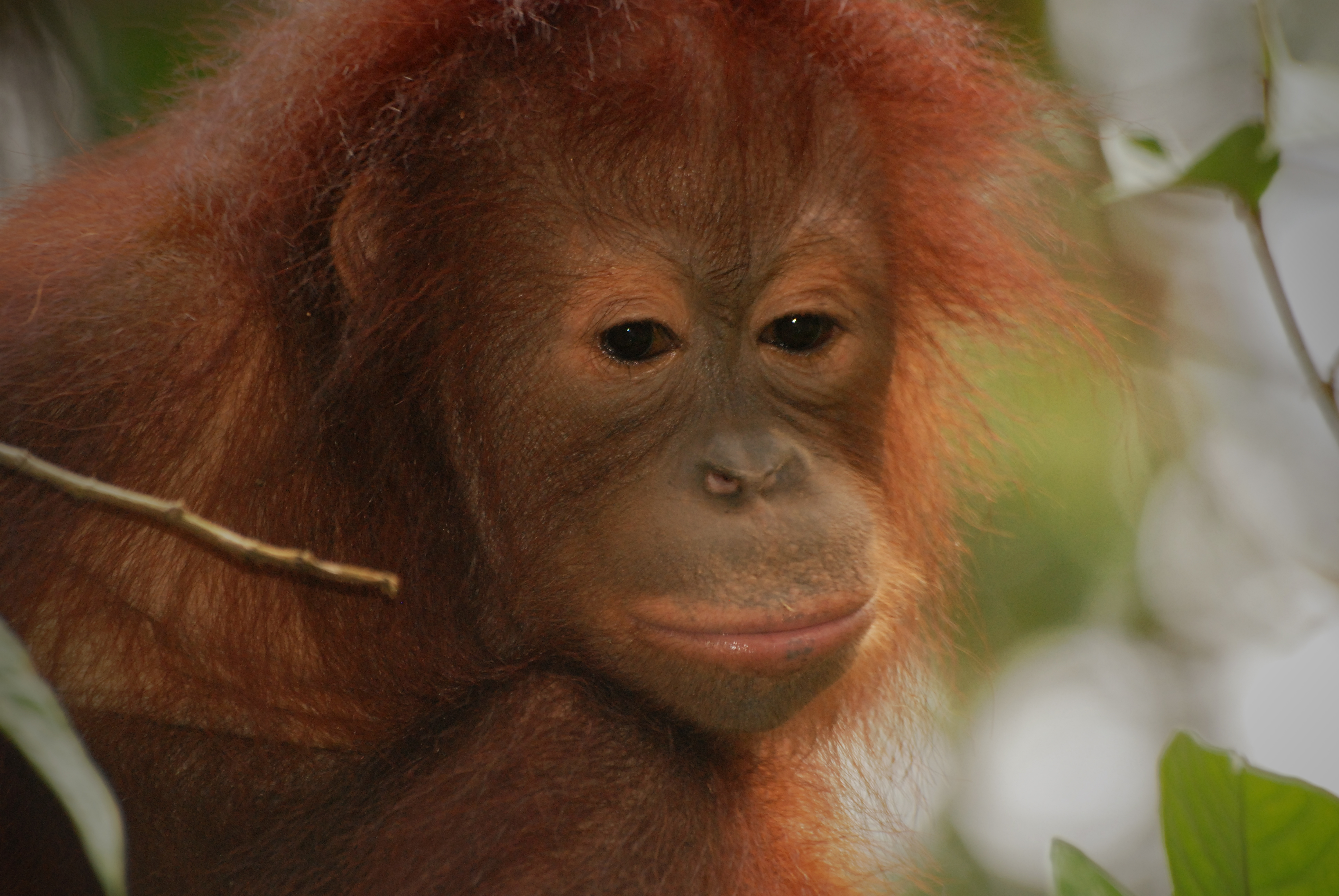
I’ve decided to post some animals I’ve met in various places for this weeks photo challenge, hope you like them!

She was the ‘beauty queen’ at a camel sanctuary.

Closer to home, in the New Forest, Hampshire UK.

A baby at Kuala Gandah orphanage.

Mole national park, funky beastie!

I’ll never like them but I suppose they’ve earned their place on this planet, Paga, where they are seen as sacred.

If you want your children’s children to be able to see me please don’t destroy any more of my habitat.


Karni Mata, facing my fear

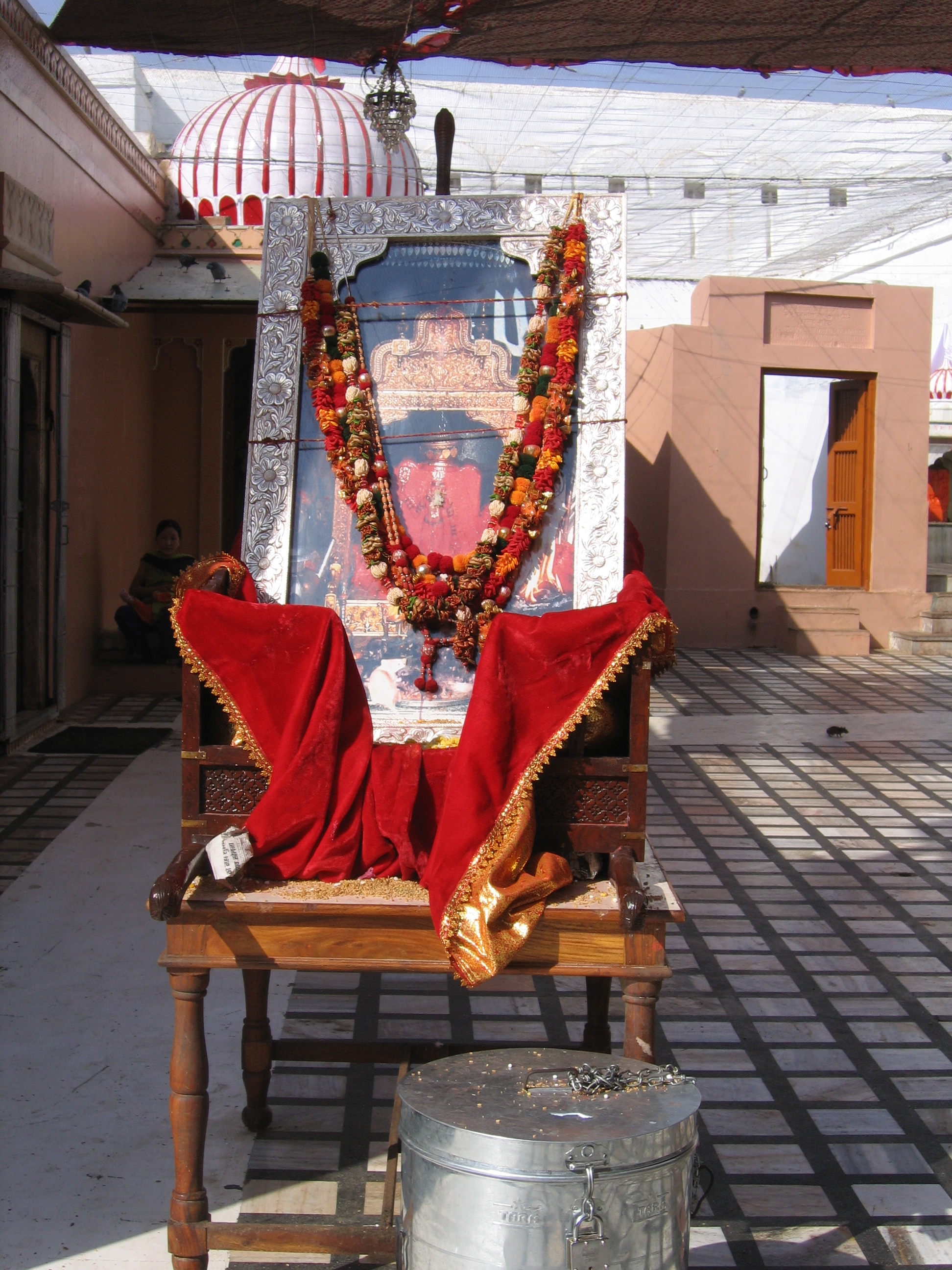
In the depths of the Thar desert, Rajasthan, stands the wonder that is Karni Mata, and bravely or foolishly we decided to visit. We had been advised to put socks on, so we obeyed and left our expensive walking sandals by the entrance in a pile of worn, grubby, flip flops. It was only 9am but the courtyard felt like a hotplate and we were grateful for the barrier the socks provided. Right away we spotted rats running along the ground. I stood still and looked around, realising there were odd ones everywhere, mainly quite still but on all levels of the temple walls, on little crevices and niches. Following the route around, I kept my head facing directly forwards, on a neck that was as rigid as the temple walls. My eyes roamed in every direction to the degree where whatever that muscley cordy thing is that stops eyeballs falling out, was hurting. I didn’t want to see them, but I wanted to know where they were and whichever way I looked I could see them. Not many, not flocks or whatever the collective term is, but a few, just going about their ratty business, dashing, pottering, sitting upright with whiskers twitching. 

The place was getting busier, mainly with Indian families, well dressed tourists, the women and young girls in colourful saris and salwar kameez, the men in smart fawn trousers and neatly pressed shirts. Judging by their appearance, our sandals probably looked less posh in the pile now.

We were being funnelled from the sun towards a cave-like entrance. Just as I was thinking what on earth is this dark hole, someone drew my attention to the walls where a series of hand prints were visible. ‘It’s the widows’ they said, ‘they were mourning and about to commit Sati . . . throw themselves on the pyre. I’d heard of this of course but having it presented to me was another matter. The rats scurrying around my feet became as nothing. How could I fear an eight inch long-tailed creature when those women had felt compelled to throw themselves onto a fire? Looking at every hand, I reached a point where the hallway turned a corner, into total darkness. My worst nightmare and I turned to look behind, meeting the eyes of the Hindi women who saw that my eyes were moist, ‘Don’t worry’ they said, ‘the practice is outlawed now, it rarely happens, keep going it’s okay’. I had to walk on and after five yards or so another corner with light at the end.

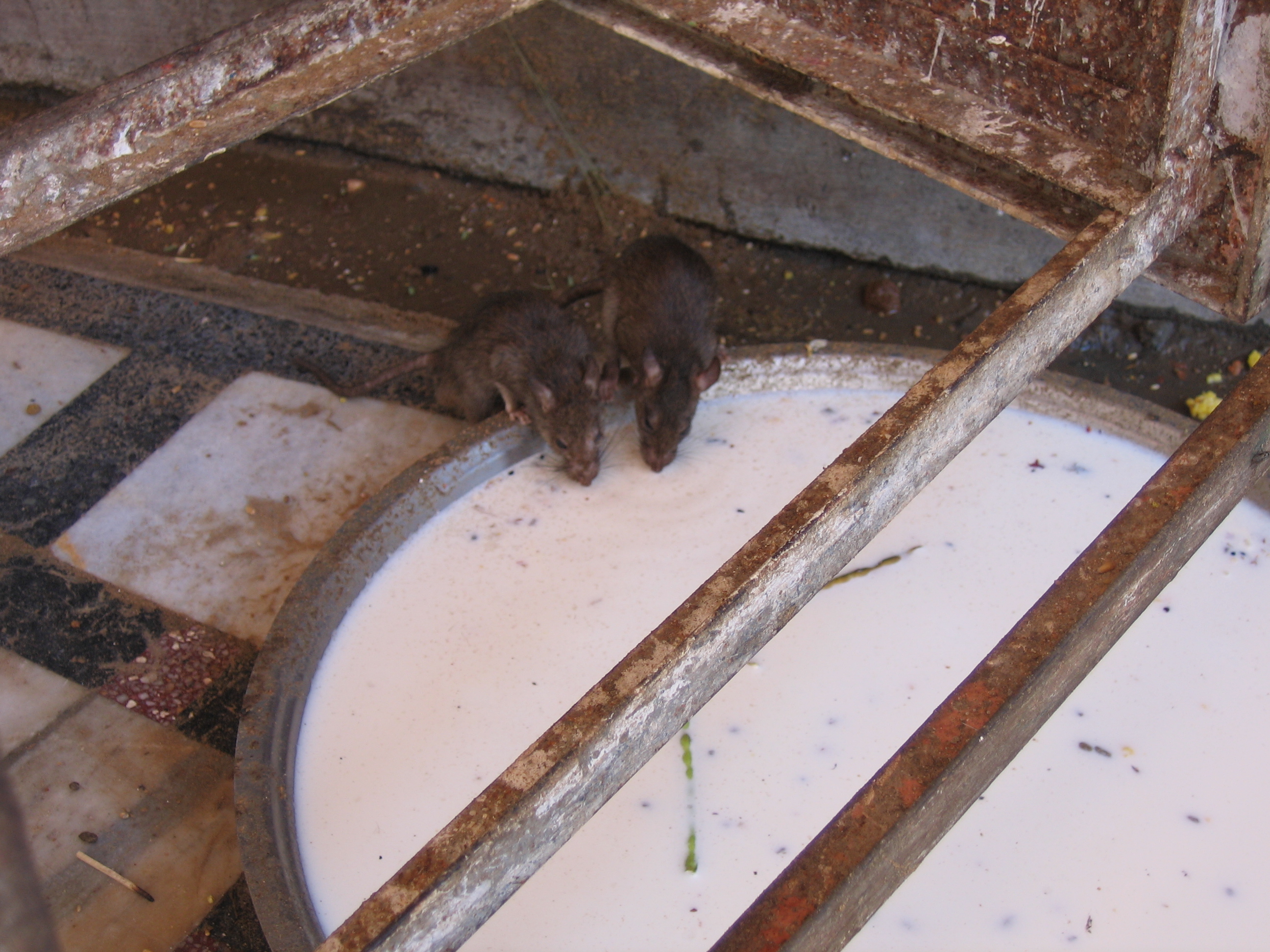
Emerging into the heat I took a deep breath and the stench registered for the first time. A bell sounded and I don’t know if it was coincidence or if the rats knew it was chow time, but far too many of them emerged and headed towards a corner area. There an elderly man had set down large metal trays of milk, which they devoured. 

I felt very queasy, but also drawn to watch, it was easier in the courtyard. It is considered very bad luck to step on or harm any of these creatures; they are revered as sacred Hindu deities. There are thousands ruling in this temple, with its ornate silver doors and marbled floors littered with droppings. Just a few are white, and I saw one, supposedly very auspicious. Having them that close made me feel really anxious. I don’t think it was auspicious for me; Karni Mata could have been where I caught the bug that made me lose three days of the journey being ill. I still can’t bear rats, but when I look back at my photos – very few because I couldn’t concentrate – and don’t have to avoid stepping on them, they look nearly, just a tiny bit cute. Apart from those tails. I’m glad I dared to visit and I’m grateful to Mugan Singh for the sock advice.