By Rail Through Somerset


country gulls flushed by the 10.53

arrow  from fields with frosty periphery

like yuletide tinsel under threadbare trees


lamb filled ewes  felted and jacketed

join blanketed ponies to nibble on nothing

awaiting a ride or a jar of mint sauce


depart the Levels undulating uphill

where railway huts stand derelict lonesome

the sizzle of pylons shoot towards ozone


old man’s beard helplessly clings to dense hide

of hedge where Roe stags lurk in dank

acres furrowed and ready  for spring


spires crack the  mist near burst  banks

where Saturday shoals of angling young men

stand fishing

and wishing


A Frizz Eased Mixed Chick

My hair and I have had a tempestuous journey to meet happily in our middle age. Little gypsy G had a globe of soft frizz, a painful tangle that had to be teased out from its tips to my scalp, a traumatic, tear stained business that makes me wince even now. I was five before I saw another soul with hair like mine; I was a bit like a rare breed of sheep, and then at infant school I met the Henry sisters, Patsy and Gloria.They carefully protected me until they went off to high school and I could stand on my own two feet because I was the brightest girl in class. Along with them went my only contact with other non white children, so the pedestal I gazed at with envy, from then on, held girls with silky locks. Around then I noticed what happened when we went out in the rain. My friend’s hair got wet and stuck to their heads. Mine? It was the strangest thing, little sprinkles sat on top like it does on blades of grass, one shake and it was gone. Apart from that and the occasional person asking if they could feel it (some just grabbing a handful) and then saying it was like cotton wool, I largely ignored it, it was just perching there.

I have a photo taken in my uniform on the first day of Grammar school and must have had a haircut for that and then no more for years and years. Instead I scraped it into an elastic band and it must have grown but it has a fragile nature so some would have broken off. I put aside the painful feelings of difference, I had no idea what could be done anyway. The odd woman could be seen in my home town with afro hair and images of powerful women like Marsha Hunt, a gorgeous creature with the biggest afro, were in the media and obviously doing okay.

I met the lovely Linda, a hairdresser who became my sister-in-law, when I was eighteen and I think she saw my hair as a challenge. I will never forget the first time she chemically straightened me. My left-to-grow locks had the smelliest gunge slapped on, it was screeched through my frizz – no I guess I screeched as it was combed through my frizz and I had to sit and wait. I emerged from her huge rollers with long smooth tresses and the feeling that I had become someone else. The next day at work a lot of people did double takes. Pretty soon I had to wash it and learnt quickly that it was going to revert when I did, unless I got to grips with big fat rollers myself! Until curling tongs, hot brushes and even blow drying arrived, I endured monthly torture by chemical to straighten the roots and even then on damp days my only option was to scrape it up into a pony tail. This first round of straightening continued for a few years until one day I went into my local chemist to buy the product and discovered it was no more. I think I went into a serious depression – for an hour – about as long as I can muster. LL then came up with the idea of perming my hair. What? Back then old ladies had their hair permed and followed it by a weekly shampoo and set! Of course I was desperate enough to try it and it worked, a whole new stinky chemical slapped on my head and I came out wavy and controllable by a new curling tong that I burnt my fingers on many, many times before I learnt. It was short back then, who remembers an 80’s haircut, long on top and cropped in short? I quite liked it until one day I overheard a little person ask his dad who that man was. My heart was on a platter and my hair has never been that short again.

Linda looked after my locks until she became ill and very sadly was lost to that nasty creeping C word. She was a truly lovely lady who never lost her sense of humour through all the painful treatment she underwent. I’ll always remember when she had a mastectomy; she needed a skin graft which they took from her lower abdomen. She laughed her head off as she showed me her patch of pubic hairy chest! Bless you; I’m sure you’re up there somewhere putting rollers in heavenly hair.

After a few visits to white hairstylists, I came across Theresa, a gospel singing, carnival costumed, Trinidadian barmcake. On my first appointment she gave me my options, relaxing or a ‘curly perm’. I chose the latter and came out looking like Whitney Houston. I know you don’t believe me, but at least two people said so. I also came out with a whole pharmacopoeia of gunge to keep it curly. Strange labels like Sta Sof Fro on pots of green sloppy stuff promised I would look wonderful. The reality? Just the slightest bit of humidity caused it to liquefy on my head and I’d look like someone had poured unset jelly on my head in some kids TV show. I don’t think I kept that look for too long.

You can relax permed hair, but not the opposite Theresa has always said and I’d look longingly at the black women who came in frizzy and went out smooth. There began ten years of relaxing. It can burn if left on tender skin a few minutes too long and if you constantly relax your roots to stop the bushy look and then start having colour put on because of the white spider web that appears on your head then your hair can end up in poor condition, as dry as steel wool! Also the whole process is expensive, I’m sure that my hair has cost me enough to buy a small farm for my rare breed woolly head, and if I could reclaim the time I could have written several War and Peace size tomes.

In Nigeria I had my hair braided with beads at the ends and I felt fabulous. That is until I came home and had to go to the conservative, prestige motor dealership where I worked, and my braids didn’t! Feeling like a Rastafarian in a costume drama I took them out. Three years ago Theresa put Ghanaian braids in for me. They were exquisite, but only until Grandmother Spider spun around, I so wish I’d had them when I was young.

I can’t pinpoint what snapped in me but suspect it was something in the media, some actress or personality with natural hair that influenced me to stop for a while. I tied my mop up while the chemicalled bits grew out. Theresa knew what I was aiming for, enough natural hair to be able to chop the rest and not have it too short. The day came, in 2009; I finally faced the world Au Naturelle. I have many, many bad hair days, but a woman who doesn’t is as rare as the woman in the moon. For now we are reconciled.

Half An Inch Lower

I have a scar on my left eyebrow. I don’t think many people know it’s there, because it’s overshadowed by a mole. Even I forget, until it’s time to pluck my eyebrows and then unlike the right one, which hurts like eyebrows do when you pull them, it has this strange tingling thing going down. Every time I remember its existence I’m catapulted back to the day I acquired it when I was a young girl living in a very different society. I lived on the edge of a rough neighbourhood that grew up when the local council built hundreds of homes in the 1930’s. They cleared the slums in the wet quarter of the city and dumped 2500 people in a soulless area that became infamous for vandalism.

There was no-one to play with in my road but one girl in my class at school lived inside this troubled circle, we were friends and as soon as I was allowed to spread my wings it was to her I flew. I never ventured to the park – that was far too dangerous; we’d hang around on street corners instead. In time the next phase of building began, this time private homes were built on the broad fields where I’d been taken for Sunday afternoon walks as a very little girl. A building site was very tempting to Linda and I – don’t ask why, I haven’t a clue what made a couple of eleven year old girls want to snoop around there. Maybe the risk of getting caught scrambling through breeze blocks and unframed doorways imagining the room they would become. It was always sunny back then, we all say that don’t we? When I was a kid summers were long, hot and dry. Well on that day it was and in the early evening we were looking for some trouble to raze when it came to us with a bang.

First came the shouts, ‘Oi blackie,’ ‘nigger,’ ‘gollywog,’ ‘we’re going to get you.’ Worst of all a ‘joke’ from some disgusting TV comedian of the day, ‘What’s black and lives in a hedge?’ I’ll leave the answer to your imagination or memory. Jokes like that were commonplace back then before the Race Relations Act was introduced and Alf Garnett argued that Jesus was English rather than acknowledging that he may have had some interesting skin tone.

I was a feisty little thing; I’d had to defend myself a few times so that night I turned to look at my tormentors, hands on hips. I even watched one of them pick up a stone a hundred yards away and take aim. I watched its arc through the air towards me, closer and closer, one of those moments when that air was pre storm silent. Ten feet, five, one, bang. Into my head, I spun with disbelief and shock.

‘Run’ Linda said and pulled me along. I tried to shake her off and somehow lost several minutes. I was vaguely aware of her returning with adult voices. I was taken, bleeding and dazed to hospital, an echoing, high ceilinged place with slamming doors where they shone bright lights to check my eyes and I could hear them say ‘Half an inch lower and she would have lost her eye.’

I enjoyed the attention at school the next day, showing off my stitches, but I didn’t play on building sites again.

Verbal racist abuse continued through my early and mid teens. I was never physically attacked again, but those years when skin heads ruled the town at night coincided with my night club age. I could never just relax and I still hate being around town after dark, I look out under my scarred eyebrow, over my shoulder.


Across the Thar, Bikaner to the ends of the earth with prickles in my salwar kameez.

Until I began researching the idea of a trip to India I didn’t know Jaisalmer existed, but once I did it had the most powerful allure. I have tales to tell about the places en route out of Delhi, but that’s for later. We left Bikaner early, to travel 200 miles across the great Thar desert, a place so hot it burns inside your nostrils when you take a breath. After some 15 miles on NH15, signs of life became scarce. We stopped for a stretch and a photo opportunity, and when the engine was cut we stepped out into the most complete silence I’ve never heard. The landscape was empty, vegetation was the odd scrap of scrubby weed, with an occasional bug burrowing around it. It was my first taste of really dry heat – the closest feeling I can compare it to is a hair dryer on dry hair, and yet I loved it. It makes little sense to be able to get so much from . . . nothing, but I could have stayed at looked at that nothing for hours.

The good Mr Singh had other ideas, and rounded up travelling friend and I into our jeepy thing, where our body temperature gradually normalised. Half way across the desert the little huts started to appear occasionally, with boys persuading a goat or two with sticks. A government restaurant was our lunch venue with an indifferent Thali – because it contained the dreaded gobi – and apple juice, for one hundred rupees. More desert road, and just as our eyes were growing heavy, looking at beige-gold sand, Magan slowed down to negotiate his way through a crowd of people. There was nowhere, no homes, enclosed land, McDonalds or anything, but somehow around twenty people had appeared, to argue over who had run over, and killed, a camel. Someone had to compensate the owner and somehow it had to be moved. It was macabre, just like hearing sirens on the motorway.

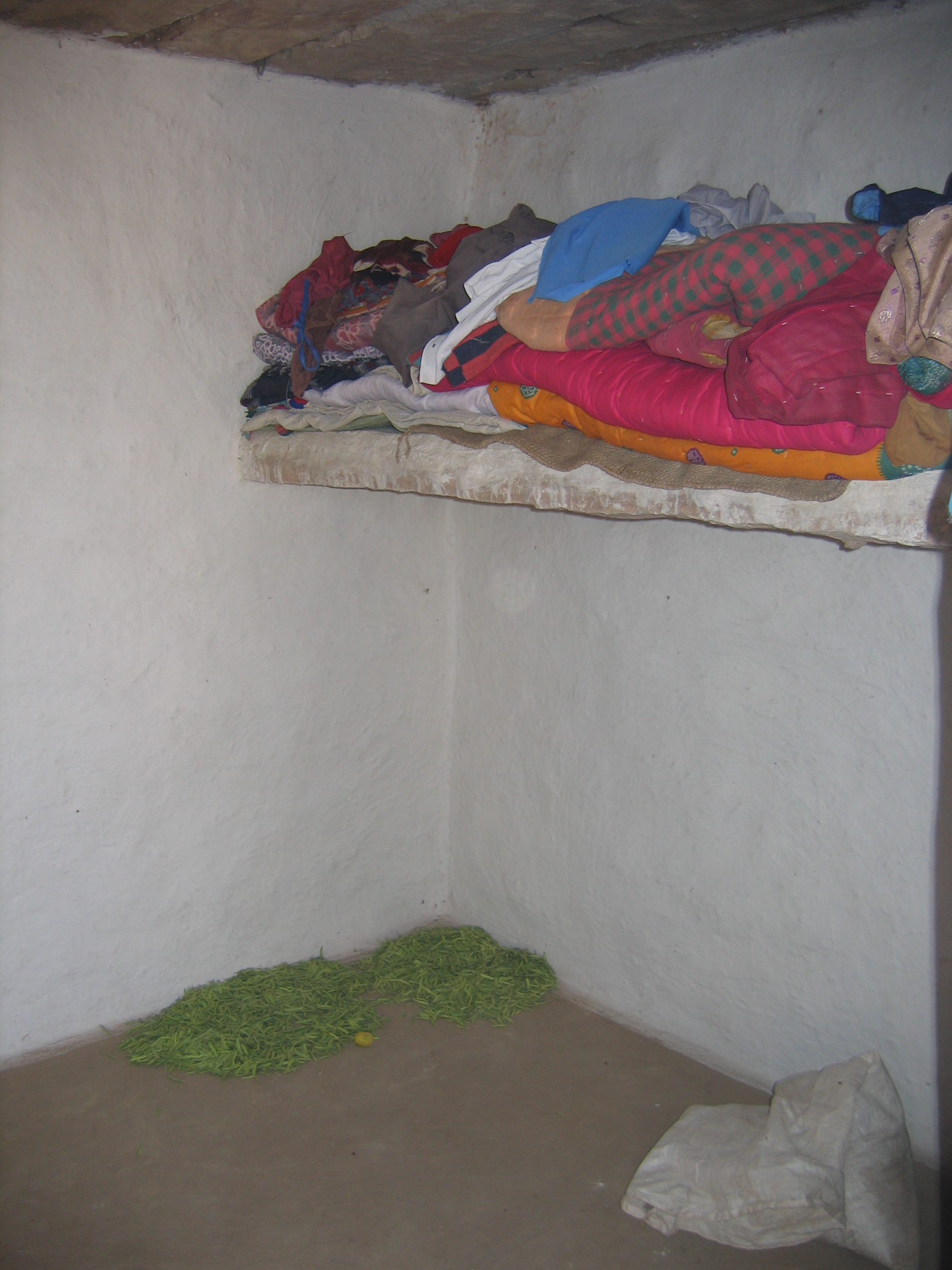
Magan must have watched our expressions in his mirror instead of watching the road, either that or he read our minds, because he always stopped just when we spotted something interesting. Later in the journey we became cynical, thinking that he had stopped at the very same place countless times, where the very same group of women always wore their best saris, for the delight of his western tourists. This time we had chosen a couple of striking brick and thatch houses a hundred yards from the road. As we took pictures some children came and invited us to visit their homes. Newly built and tiny but with a bed for each person, some shelves for clothes and one had a fire to cook.

Outside, another charpoy bed was under an open sided, four post shelter. In all there were three adults and seven children, the sum of their possessions would have fit under my kitchen sink but they were so happy and proud.

To celebrate Dussehra they had painted a Rangoli, a bit like a mandala, in white on the pressed ground that was their courtyard. The oldest child, a girl around twelve asked for shampoo but as Magan said we should not start a precedent, we gave them only sweets and they were very happy.  He told us that they would tell the story of our visit for the rest of their lives, we would never forget them either, it was an encounter to cherish.

The countryside from then on was sprinkled with villages and a few military bases, including an area where nuclear testing was carried out in the past. In the greener areas there were castor oil plants and kedgeree trees. We knew were approaching civilisation when there was enough irrigation from ‘tanks’, concrete reservoirs, to grow water melons. Rather than the red we are accustomed to, these were white fleshed and Magan smashed them against rocks for us, a welcome treat.

Magan had a wealth of knowledge to impart including about turbans:-

Men wear them to protect against heat.

They can be used as a towel

They can be tied to trees to use as a hammock.

They can be used as a bag.

And, different colours represent different families.

Our last stop before Jaisalmer was when we saw some women working in a field, Magan thought we wanted to take more photos, but before he noticed, I started to stride across to talk to them. I’d gone a little way when I heard him call me so I turned to wave and carried on. He called louder and sounded quite panicky, but because he was such a mother hen worrying about his Western chicks, I ignored him. He ran after me and looking like he was going to cry, pointed at the bottom of my salwar kameez. I was covered in hideous, prickly, seed heads that had buried themselves into the fabric and were agony to remove. He was mortified, poor man.

We arrived at a point just outside Jaisalmer, an ancient city at the end of the earth and stood to absorb the view. But you’ll have to come back again to hear more.


My Photographic Journey

I had a disaster yesterday. At least what amounts to a disaster in my little world. I went out for the afternoon to try to get some decent photos to use for my course assessment and took two lenses. Now, I hate carrying things and try my best to travel light, but you know how women just have to have certain things with them? So yesterday instead of taking my main handbag that weighs a ton and slides off my shoulder whenever I try to take a picture, I took a tiny little bag that has lots of sections and padded it out to take my zoom lens along with the usual essentials. Going outwards on the walk in Shaldon I used the camera with its standard lens and at the furthest point, frustrated by my crappy shots, I changed to the zoom and put the standard into the camera case. Got some slightly better shots but not really what I was hoping for, the views across the estuary to Teignmouth were invaded by industrial warehouses.

Shaldon was a delight to wander around though, there was a decent butcher and a divine bakery (I’ve just had their tomato bread warmed and filled with cheese for lunch) with lower than supermarket prices. Back at the Ness car park, having snapped all the way, and in too much of a hurry, I rummaged for the zooms lens cap in the camera case. Unfortunately the case was at a funny angle and out fell the lens, landed with a clunk on the tarmac and rolled into the verge. I swore as I bent to pick it up, there was a brief moment before it fully registered and then I burst into tears when I heard the rattle of shattered glass. I cried all the way home and for most of the evening.

If you know me well, you’re probably wondering why I’m making such a fuss about something material that can be replaced. You may be thinking that it must be insured. Well I’ve had it three years and never had a problem before – believe it or not I’m very careful – and when it was due for renewal in June I decided that two hundred pounds to insure the camera and its lenses was more than I could afford. I’ll now have to spend that much to replace it, sometime.

So why the strong reaction? I’ve never been a dropper or breaker of things, been tempted to be a thrower of things at times, but as I have a scar over my left eye from having a stone thrown at me, I never will. It took me a while to work out the cause of my tears, it wasn’t something being broken, it was about a photographic item being broken. I had my first camera when I was about eighteen, a Kodak Instamatic no less, a cheap, simple to operate little thing that produced small square prints. I couldn’t afford to take too many photos, the cost was prohibitive and continued to be for many years. But even then I had a good eye and could see many, many photos crying out to be taken. Being a mum was the priority for many years and I was never in the position to own a camera. Just before the dawn of digital I bought a nice little compact 35mm followed by my first canon digital with just 3.2 megapixels but I took some good shots with it. That was in 2003 and two years later I upgraded to a 5 megapixel Canon and then I was away, teaching myself to use Photoshop 7 and using my photos to make cards, some of which I actually sold!

In 2008 a dream came true when I got an eos 450d with two lenses and the following year a third. I’m still learning to use it and I think I’m getting there because it’s set to manual these days. My ‘eye’ has grown faster than my techie skills could ever keep up with and if I’m honest there’s a limit to how much interest I can drum up in the ‘sciencey’ stuff I’m supposed to be learning on my Open University digital photography course. That’s where I am right now with photography. I wonder how much more skilled I would be by now if I had been allowed to use the equipment that had been in my house for most of my life? But I wasn’t, instead I was always told to leave it alone, don’t touch it you’ll break it, it’s too complex, delicate and expensive, and the  bottom line YOU’RE TOO DAMN STUPID TO USE IT.

And so there I stood yesterday in shock as my expensive, delicate, complex lens crunched to the ground and shattered. Is it any wonder that I cried? Now I’m okay, for the first time ever, I have by my carelessness, allowed something to break, but it really isn’t the end of the world.

Friday Flash Fiction: Mystery Lady on the Train

Mystery Lady on the Train.

Are you the lady who was

Travelling from Exeter

To Torquay on Friday

28th October? We met

At Newton Abbot and

Travelled on the 11.30am

Train to Paignton. You

Left the train at Torre to

Visit a friend in Torbay

Hospital. Would be so

Good to hear from you.

Yes actually that is me. And I could hardly forget you, ever. I have never had an encounter where my heart felt so touched. No that doesn’t do it justice, because you touched my soul, and for a week this soul has drifted between heaven and hell. Heaven because I was privileged to spent those hours with you; I’ve never been so happily delayed. Hell because I’d lost you so quickly. I thought I would never again see the way you wrapped your hand around a cup or smiled a thank you. By now you should be at home in Cincinnati getting ready to spend Thanksgiving with your daughters. I’ve read about the extreme weather out there and tried to imagine you shovelling snow from your front porch. But you’re still here in Devon? And you’re hoping to hear from me? Badly enough to put that ad in the newspaper. I left you my paper that morning; you said you would try to finish my crossword. I’d laughed and said we spell things differently here; you’ll need to use a pencil.

Why aren’t you in Cincinnati? Were you searching for me? Strangers on a train. No it’s just too clichéd, impossible, why would you, no why ARE you searching for me. No-one else left the train at Torre, no-one but you leant out of the window until it disappeared.

I’ll call now.

But where will it lead? Surely there’s no point, no future. I can’t leave here and you can’t leave your girls and the US. No, that was it, a brief moment. I could have bedded you in an instant, but have only the sense like a sigh where your hand hovered over my shoulder. I wonder how long I can keep that moment in my mind. For now I feel I will never forget, but we all say that don’t we? Until life gets in the way. I’ll still remember at Christmas when I imagine choosing your gift. You told me you’re an Aries so I’ll check your horoscope along with mine. By summer I’ll think of you less often, and accept that you probably just wanted the name of the book I told you about, a quick lunch before you flew home and that I fooled myself into thinking that you reciprocated.

Besides what would people think? Silly woman you can’t get involved with strangers. There are some weirdoes about. You’re so naive. At least it’s not as bad as when you pick up hitch hikers. My friends would all have something to say. We have more to say don’t we? Where’s that number?

Zero . . . seven . . . nine . . . five . . . five . . .

Hitching a Ride

Which of you have ever hitch-hiked? I have. And loved it. But that was way back when. When The Faces had not long lost their Small, flowers were still in our hair and I spent my summers picking strawberries to save for a Transistor Radio with –  wait for it – EARPHONES! so I could listen to Radio Luxembourg under my sheets. Kim and I would walk along Topsham road; look at the road signs and think, Torquay today? With no map or any idea where it was, we would sit on the edge of the road with our thumbs out wearing hotpants that barely covered our whatsits, and surprise, we never had to wait long for a ride. We saw a lot of Torbay that year and it certainly beat walking the ten miles to Exmouth as we’d done the year before, desperately aiming for Pink House Corner, the landmark where we had broken the back of it.

Most often our lifts were lorry drivers who happily shared their sarnies, Spam or cheese with red sauce on white bread with margarine. Better though were the couple of times where we struck gold with travelling salesmen, who took us to roadside cafes in flashy cars. Any car was flash to Kim and I though, neither of our homes had vehicles. Torquay’s sea front stretched a mile or so to the harbour and then just a choice of two streets up the town via the dazzlingly tacky amusement arcades, ice cream parlours and chip shops. It hasn’t changed much, apologies to any Torquastas reading, but apart from the gloriously expensive Ilsham Marine it’s all a bit predictable isn’t it?

A couple of years later I saw an article on what was then Westward TV about a tiny place in Dorset – Whitchurch Canonicorum, telling the tale of a shrine to St Wite http://www.darkdorset.co.uk/st_wite Why this particular tale pushed buttons I can’t think but I just had to go and see it for myself. My chosen victim, no companion, on this saintly search was my best friend of the time, Sue Leichman, who disappeared from my life shortly after, possibly with a morbid fear of what I’d drag her into next. We got a ride on the A35 but must have walked a good way from there into murky Dorset. I vaguely remember a tiny church and trying to find a way of stretching the time we spent there to justify the effort involved. I have no idea how we got home again. To be honest I can’t ever remember how we got home from any of our adventures, I ‘m just grateful.

I don’t think I went hitching many more times after that, but back then it was exciting to see how far we could get for free. It was commonplace then to see people on the side of the road looking hopeful and it’s sad that the majority no longer feel safe to try.

In the late 1990’s I was driving towards Southampton and ten miles out on a grim, damp morning I saw a young woman on the side of the road with a sign saying London. I slowed to check her out. She looked about seventeen and really cold and scruffy, of course I had to pick her up to make sure no-one worse did so. She threw her backpack in the boot and before she touched the seat I could smell her! I opened my window wide and put the heat on full. Her hair was matted, her clothes raggy and she looked malnourished. She walked from Fairmile to the main road. The old A30 that is, and she had spent a month in the trees with Swampy and the other environmental protestors trying to prevent the construction of the new A30 bypass. We parted company before too long, I took the low road and she the high for London, but it was an interesting experience and insight into their treehouse and tunnel life.

A friend told me recently that she picked up a man hitching to near her home town, a total stranger and she a lone woman. Others had criticized her and questioned her sanity but she said she could tell that he was okay. How did you know? I’d asked. She couldn’t give a precise answer, she just did, ‘Sometimes you just instinctively know.’ Apparently it was an enriching journey where the stranger shared all sorts of anecdotes of his travels around the UK, always by thumb and cardboard. Hitching is largely gone, but not forgotten.

Gonna Be a Big Man Some Day

He climbed into the boat with eyes wide and fearful and then squinted towards where he knew his destination should be, far across the lake. Grateful to lower his pack from his head – it was so heavy that it felt as if it was pushing him into the earth – he tucked himself into the driest corner he could find and used it as a seat. A middle aged woman sized it up and silently daring him to complain she deposited her abundant bottom beside him. Once they both knew she had won, she took some bread from her bag and passed him some and even though he’d had some rice before he left the village, he would never say no to food.

The boat started filling but it was the first of the day and the ferrymen knew that once it was three quarters full, it was pointless waiting for more passengers. His mother had woken him early to have the best chance of getting to the other side ahead of the crowds. He had the garments she had made and was taking them to the market, on his own for the first time. The ‘All To Jesus’ engine fired up and they gently steered a path through a flotilla of similar boats, still moored, as they left Yeji. The ferryman looked skywards, said a prayer and sang along to the gospel music that was blaring from the beach. Others joined in, but the boy was too shy, so he pretended to check that his pack was secure. It was going to be a scorching day, and the boat boys raggy vests were stuck to their bodies already. They were bailing out the pool of water, which threatened to drown the crated chickens, with small metal pans. He was only a little older than them, but he thought himself too grown up to chat or play their childish games. He believed that he had an important job to do, the start of his new career as a market trader. They turned away, and made percussive sounds with their pans until the ferryman shouted they were out of tune.

The woman beside him delved into her bag again and brought out a stew pot wrapped in cloth. As she unwrapped it, a smell so pungent flew to his nostrils that he reached in to grab himself a Kenkey, she slapped him hard.

‘You have Cedi? Give me Cedi I give you Kenkey,’ she knew he had no money and planned to give him the leftovers, but first she sold nearly all to the other passengers who gathered round the pot and dipped into spicy pepper soup. The remainder she shared with him, ‘Because I know your mummy and your big mummy also.’ He thanked her and said he would help with her bags on the other side.

With everyone’s bellies sated the boat gradually fell quiet in the heat. He began to think of ways to shelter from the sun. He’d seen slit eyed tourists from across the world going around the big City with umbrellas over their heads. They didn’t want their skin to go dark, especially the women, who seemed frightened even to have the sun smile on them. Maybe mummy could stitch a cover for a boat like this he thought, and then the ferryman could charge more to keep his passengers cool. He decided he would price some white cloth and tell his mother his idea. He was so absorbed in how they would spend the riches his ferry umbrellas would bring, maybe he would go back to school, or just work hard to become a big man, that he didn’t notice the noise at first. And then everyone was shouting at once.

‘What is happening mummy?’ he asked the stew pot woman.

‘Shush boy, keep your head down and pray, they go rob us.’ He felt spice burn as his food rose in his throat, so it was true; pirates had left the ocean and were on the lake now.

Two men, heads wrapped like Bedouin, one wearing a traditional shirt, the other a T shirt emblazoned ‘Chelsea’, boarded the boat with machetes in their hands and ordered them to open their baggage.

‘You, give me your watch and get on your knees,’ the Chelsea pirate demanded of a westerner. The boy made himself as small as he could, watching and listening. He saw them drag a tiny child from its distraught mother. The one man, with scars on his arms and a bird skull strung around his neck, spoke tenderly to the baby, smiled as he pinched its cheeks, and then looked at everyone in turn, before throwing it towards his own boat. The mother screamed as if her heart had been torn from her body and it seemed like they all held breath until another man caught it in his arms. The boy looked for a way to help.

‘How much for the baby?’ ‘Who has money to keep it from drowning?’ Angry voices broke as people argued and pleaded with them to have pity on the mother. ‘This child may fall in the lake if no-one has money for me.’ Pockets were opened to find Cedi, goods were offered and all the time the pirate looked at the westerners.

‘Give me Cedi 500 and we will leave in peace,’ the voice coarse and demanding.

‘I don’t have that much, only . . .

‘Your wife, get her wallet and give me all you have. Hurry the child is getting heavy and will fall soon.’ The mother threw herself on the westerner who got to his feet and handed over the cash. A jerk of the head signified that his shoes were wanted too; they were swapped for the child and the boat roared off into the heat haze. ‘Quick, quick, we must go fast now’ the boy found a voice, ‘Of course we go fast, far away now and we go Water Police’ the ferryman replied, cranking the engine up. The boy watched intently as the distance opened between the two boats, ‘Look now, they have stopped’ he said, they squinted at the pirate boat that had indeed stopped and seemed to have trouble starting again.

‘Is this important?’ he asked holding up a length of hose and a chunky bolt.

‘Boy, how you get that?’

‘I pulled it when everyone was shouting and screaming.’

‘They go nowhere now less they paddle, is a long way to land, you go grow up like big man, give him palm wine. Hallelujah, praise His name.’

And the boy was blessed.

Learning to Swim

Julie Abbott had fallen in. The pool was packed with wet, white bodies like a bucket of angler’s maggots and she’d fallen, slithered on the bottom and choked on the piss-polluted water. Hands soon found her tummy and took advantage of her vulnerability to let fingers rove into the elastic of her yellow shirred cotton costume, tweaking it, fumbling and pulling it aside to invade her in the chlorinated wet. She struggled but was grabbed by a constrictor arm so firmly that the other was free to carry out its rotten work. Her head was thrust clear of the surface but her body was ground hard onto a solid seat of muscled thigh, her first inhalation was of cider tinged breath through teeth that seemed wonky to her stinging eyes. In the midst of the raucous din she heard her friend’s worried voice,

‘Jules, Jules are you okay?’

Julie was released abruptly, her pseudo rescuer vanished into the throng leaving her snorting a mix of pool water and mucous back out of her nose and with a confused sense that something strange had happened.

‘I’m getting out Carol’, she coughed, ‘I feel a bit sick cos I’ve swallowed some water and grazed my knees on the bottom, I’ll see you in a bit’.

That was Julie’s first attempt at swimming in the City baths and several pubertal years passed before she returned. As a fourteen year old she was a pupil at a girl’s grammar school who ordained that everyone should achieve at least a grey swimming certificate. She had a vague unease that she couldn’t quite account for, but it was strong enough for her to plead menstruation for three weeks in a row and get away with it. For those three weeks she had sat on the balcony to watch, but that day for the first time she was alone. She heard the groan of the stair door closing, thought it was another girl skiving off and didn’t even raise her head from her comic when someone sat beside her. When a male voice said,

‘Fancy a kiss?’ her skin prickled like nettles and she turned and looked into the eyes that had appeared in her sleep many times. In a flash she understood, she knew at last what had happened all those years ago, there was no doubt.

He grinned, exposing a furred tongue that flicked downwards towards the folds of his chin, Julie’s belly churned and her vision distorted with images of nearly drowning mixed with a real fear of the man beside her.

‘Go away I’ll tell’, she tried to shout but it came out as a croak that ebbed away under his hog laugh,

‘Ha ha ha, what? I saved you, you would have drowned! Bet you’ve never been kissed, come on you’ll like it, have a try’. He was right, most of her friends had boyfriends, and Mandy Davey had gone all the way. Her memory had been of someone old . . . but . . . he wasn’t really was he . . .?

‘How old are you now then, sixteen? Sweet sixteen and never been kissed? I’m twenty four’, he must have read her mind. ‘I’ll buy you some chips and a cola float at Wimpy after or come back to mine for a gin, my flat mate’s away it’ll be just us’. She decided that maybe he wasn’t so bad. As he reached out to grab her she noticed ginger curls on the side of his hands, she thought it strange that he had soft hands and not the rough arms of her nightmares. And then his mouth was on her, he swallowed her with a gob so wet she felt she was dissolving in his spit. She wriggled but had no strength compared to his toned swimmer’s biceps, she couldn’t breathe and his tongue was deep in her throat. With his hands tugging her blouse, she remembered the same feeling of breathlessness in her nights of fantasy with a pillow, a Jackie mag and her David Essex posters.

Something happened down there inside her, she was aware that she was making a noise but it was muffled with the splashing of normality and the lifeguard’s whistle. He pushed her, fingers probed where they’d never been and weren’t meant to go, it hurt. Panting she pushed back harder.

‘Stop, stop, hold on a minute I’ve got to meet my friend or she’ll come looking, I’ll come back.’

‘What come to my place? Good girl I’ll look after you, you’ll see, be as quick as you can.’

Virtual Stress

I’m feeling overwhelmed and I’m only at the beginning of a ten week, ten point, OU photography course. As always with the OU there are forums and because I’m looking out for locals and trying to get the best learning experience I’m reading most of the entries. We all strive to slot ourselves into place in groups, in this case to find where we are on the scale of photo duffer to Cartier-Bresson and having looked at lots of other students work, I feel comfortable enough with my abilities at least.

The course hasn’t even really started yet and already there are 2300 photos on the website and so I’ve given with the national community to concentrate instead on the group of eight that I’ve been placed in, in theory only around eighty photos. We’re all supposed to comment on a few and as there are about fifteen comments on mine I’ll have to try to return the favour. In between that there is a Facebook group for this course, one for a mixed arts group and one for the course I begin in February.

I should, no I hope, to be able to learn how to use the software they sent me instead of my usual bumbling around, guessing how things work and then never being able to repeat a particular way of editing a photo. And these ten weeks are my best hope.

Guess what I’d really like to be doing? I want to be writing my blog, I want to write Lake, Music, Boat as prescribed by Denny Lesniak, and I want to write up a travelogue of Ephesus and another of Cappadocia, to say nothing of reading the blogs I’m subscribed to.

My inbox is groaning under the virtual weight of unread mail and an hour of tonight was wasted on internet banking trivia. It’s 21.07 and I think I’ll have to crawl into my nest (still no time for eyebrow tweezing) and hope that not too much happens in my virtual world before I get home from my real world at 8pm tomorrow!