Raku Cats and Amethyst, the Archaeology of Me

Naturally I want to leave behind something wonderful that creates a perpetual image of an interesting woman of the third millennium AD. But what is there to me really, what makes me ‘me?’ I have watched documentaries about the spread of mankind around the planet, the long walk from Africa, and have often said that all people are African, but some are more African than others. Half of my genes are English and I stake a claim to those being of good Celtic stock. I feel a strong tie to this south western land of green hills, red sandstone and mellow climate, and feel that I’ve been here a long time. But I may have only arrived with the Norman Conquest, with the Vikings, or on a coach from Llandudno. My other half is from the West African Igbo tribe, but those borders were only laid down by the raiding Empires in the last few centuries. My late father, who I strongly resemble, was not the blackest of Africans and could well have descended from Arabians mixed up in Saharan territories. That would account for my love of desert.

So who do I think I am, to be able to leave something wonderful? I shall leave my genetic fingerprint and hope that it continues to walk, in a lucid gypsy manner, around the globe.

But of material things, what will remain after I perish and return to dust?

In the 70’s I had a passion for ceramics from the Troika pottery in Cornwall and have just four durable pieces. I treasure a small, white, china bell decorated with a butterfly and ‘I love you mum’ in red. I’d love someone to find it intact in a thousand years and try to imagine me! Sat beside the television is a near life sized Raku Siamese cat by Dillon Rudge, well known in these parts. The beauty of the Raku may be a weakness that would cause it to fracture, but perhaps a 25th century archaeology student would be given the challenge of painstakingly re-assembling it. There is a French silver frame, the picture would fade away and the glass would shatter, but the tactile design would last as would my few gold rings and silver bracelets.

I make beads from polymer clay; if it’s accurate that carrier bags will not decompose for hundreds of years, then the beads should not only survive, but turn up around the world, as a few foreign tourists have bought them. Few can say that they don’t use plastic; I for one, have thrown away countless empty bottles, from decades of buying products to ‘manage’ my difficult hair, not the legacy I wish to be best remembered for. What would a future scientist conclude from an analysis of the traces left in one of these containers?

The most permanent possession of mine that will remain, is one that I am but a transient caretaker of. It’s been around for millions of years, and unless deliberately sledge hammered, will be around for millions more. Amethyst is mentioned in Greek mythology, mine is a small geode, most likely from South America, but possibly from Africa, as things are.

(With thanks to my friend Kathy whose Facebook post inspired this piece)
Growing, somehow.

Growing, somehow.

Crying, why? Depression.  The big saucer eyes red and lower eyelids exposed and vulnerable looking like raw meat, angry, red and sore. The skin on his face was prickly with grey stubble, dry unkempt and with traces of white soap. The ruddy skin of the outdoors worker and long -term drinker. Fleshy folds of jowls, mouth loose, narrow lips. Dentures were in the pot beside the bed instead of in his mouth, so that the structure was gone from his face. He’d put them in and when he smiled he looked lovely but he played with them with his tongue, pushing them up down, in and out of his mouth and scary to a little child, who thought they had a life of their own and would bite by themselves.

As he aged there was dribble from that slack mouth and corners were cracked and sore.  But mostly it was the crying. Always there was pain, headache, debilitating agony all over his head. No drugs worked and he had lots of those, all the anti-depressants of the day were tried. The doctors used him as a guinea pig. He had Valium, Mogadon, and Triptizol and reporting side effects he changed them frequently never allowing any time to get into his system as they gave him headaches, made him groggy, kept him awake – whatever he went from one to the other and then back again.

Occasionally some crisis sent him to the trick cyclist hospital where he stayed for a few weeks. Sometimes that meant they gave him electro convulsive therapy which frightened him terribly and he would cry even more. He was frightened most of the time. Of death, of what was and might be going to happen to him.

Back to him. Those nasty hospitals, old style Victorian buildings that began as lunatic asylums with people that had been there for decades, padded rooms and strait jackets for those who couldn’t be controlled – for whose safety? The child visited and was afraid of him and the other patients. She was very sad but with no way of expressing any emotion, she took it back inside herself where it festered for half a lifetime and could easily have caused her to travel the same narrow, dark tunnel of despair. Fear, hindsight and education gave her some understanding of the possibility land he inhabited. He never went to the war in 1939, although he was twenty seven at the time, he was supposedly not fit, because he had a cycling accident, where he ‘cracked his head open’ and they put in a steel plate. Would that have been likely in the 1930’s? Did such procedures exist back then? If not it would have taken some imagination to conjure that one up.

So, no war for him, he joined the Home Guard and there were remembered whisperings that he had been called a coward. Or was he? Was that maybe something seen on a black and white Sunday Matinee in the 60’s? That war avoiders were called ‘yellow’? So that bicycle accident may have caused damage to his nervous system and lifelong mental illness.

He was a simple soul but he taught her about his small natural world. Look out for adders they can kill, how to dig a trench and plant potatoes, sowing and pricking out seeds, putting salt around slugs and watching them sizzle or how to tell a plant from a weed. When she was little he worked on the land. Each day he got on his bike and rode the mile to get there with sandwiches packed in greaseproof paper and a paper bag – several times re-used. There was no money so they were scantily filled with the cheapest mild cheddar which was always ‘tasteless muck’, dripping – from some scrappy roast dinner  kept in a china pudding basin on the cold shelf of the larder because there was no fridge, or streaky bacon that was invariably ‘salt as brine’. He complained all the time, nothing was ever good.

Because he hated riding his bike in all weathers he was grumpy and she thought that he had returned from a long journey each day, it was only as an adult when her world shrunk that she realised just how close the farm was to home. The farm owners were good to the family; they tolerated the fact that most weeks he would have a sick day, sometimes two. He only left when they sold up and retired. Perhaps it’s surprising that he rode his bike at all when falling from one had caused him so many problems. It was the victim of many punctures and frequent visits were made to the cycle repair shop for a puncture kit. Occasionally great disaster fell when an inner tube or tyre had to be replaced, a major expense. Spoons would be used to lever the tyre on and off the wheel. The child longed for a bike of her own. She would beg for a ride on his but he wasn’t often in the mood to lead her round on it. It was huge, dark green and very heavy. The cross bar prevented her from getting on independently but she kept trying right until her teens when he had no use for it anymore. Then she would wheel it across the road to the pub forecourt, lower it sideways enough to get her leg across and leap on but could never sit on the seat and reach the peddles. She has vivid memory of falling on the crossbar, agony for her warm flesh on the solid cold steel. To this day she is a very poor cyclist.

It’s strange that I’m writing this on Father’s day, I woke up this morning thinking of him and there are lots of stories I could write. For the first ten or so years of my life he was dad and then for the next thirty I didn’t know who dad was. And then Pa Claudie was found, as was a big chunk of myself. So where are they this Father’s day? Lost to me for good this time, but I like to think they are watching over me somewhere and feeling some pride. Bless you both.


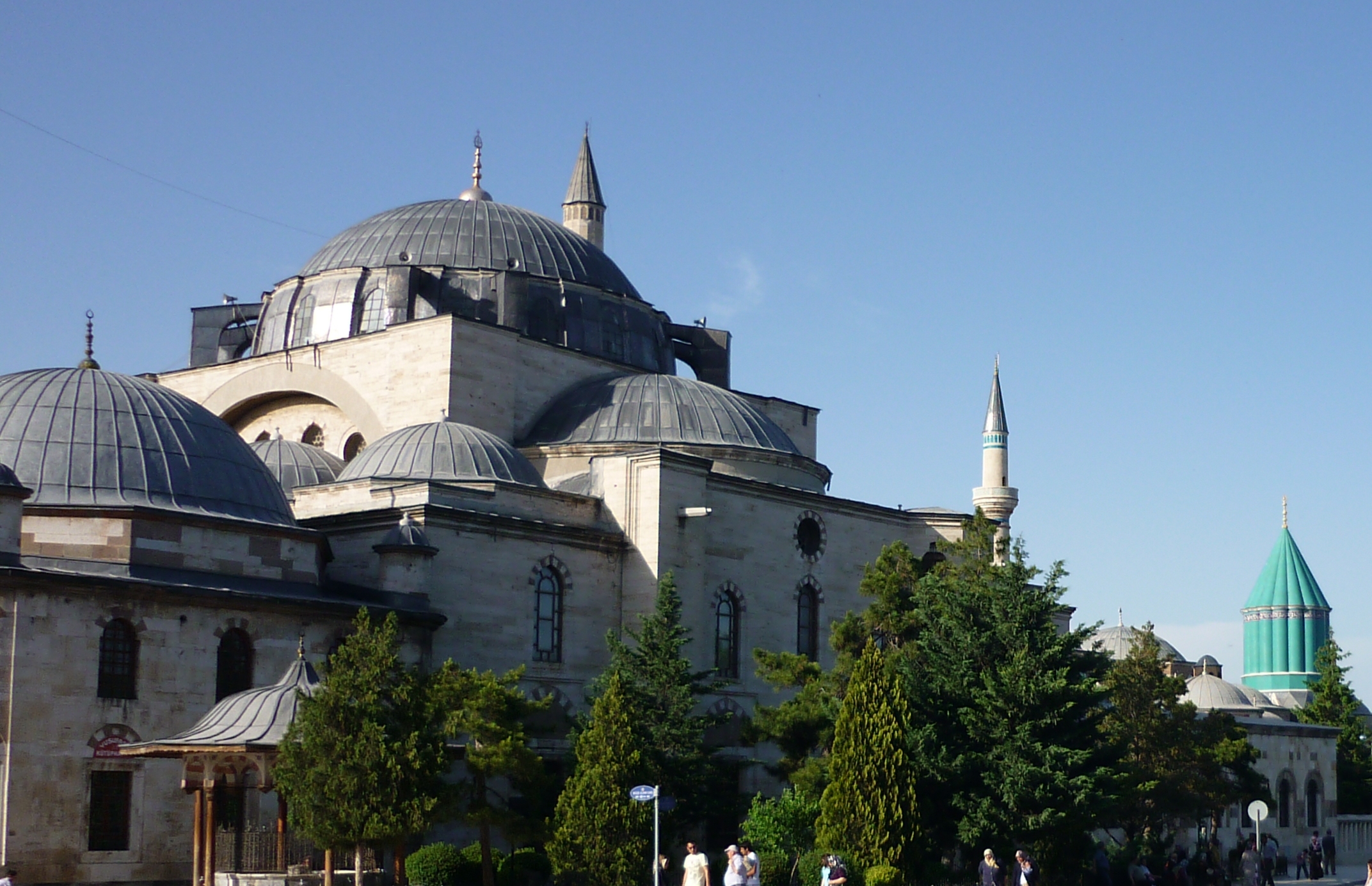
Konya, Mevlana-Rumi and Selimiye Camii Mosque

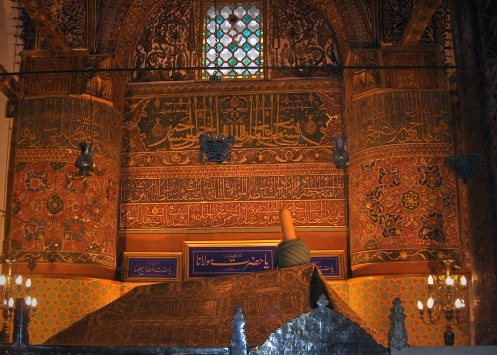
Konya is reputedly the most devout city in Turkey and when we arrived in the hot late afternoon it certainly had a different feel to the other towns along the way. We were directed towards the exquisitely tiled tomb of the Sufi mystic Mevlana, also known as Rumi.

The mausoleum holds a collection of ancient Korans, some very tiny, some gilded, and a carpet that is supposed to be the world’s most valuable. We were the only westerners and attracted a lot of warm, curious stares especially from a group of teenage girls. They giggled at us behind their hands and never one to miss an opportunity I said hello in my best Turkish, merhaba. They blushed and giggled even more. I tried ‘Where are you from? What is your name?’ and a slightly older girl was pulled to the centre of the group. ‘Do you speak English?’ I said ‘Yes I am English.’ There followed a sweet conversation where through her they asked questions and looked at me strangely. I knew they didn’t get me – I was wearing a scarf around my head and shoulders, so because of my skin they thought I must be Muslim. I explained that I’m from England but am half Nigerian and watched the quizzical frowns smooth to happy smiles. I could have stayed all day but eased myself away to look around and every so often I’d turn a corner and catch one of them smiling.

I was drawn to a crowd gathering around a glass case and edged closer to investigate. There was an ornate casket inside and people seemed to be taking turns to press their nose to the corner of the case. I tried to keep a respectful distance, but again the friendly glances and they started to talk to me. I understood nothing but a woman took my hand and led me closer. I was instructed to follow them in the nose pressing activity, and saw a tiny hole that they were inhaling through. A sniff revealed a jasmine frankincense aroma, and a sign in English, that the casket contained the beard of Mohammed. Later there was a debate among friends as to whether it was supposed to be a hair from the Prophets beard or that of Rumi, this remains cloudy, maybe someone knows the definitive answer?

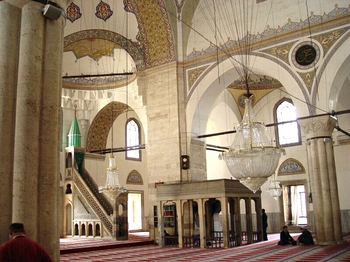
Through abundant rose gardens stands the Selimiye Camii mosque, 450 years old with sumptuous decorations in the Ottoman style. Friday prayers had ended and I approached the door. In contrast to the bustle of Rumi Mevlana’s tomb hardly a soul was around and my friend sat in the sun while I tried to find out if I could go inside. I was nervous, in one of India’s most important mosques, the Ajmer Dargah,  non Muslim women were not allowed to enter and I had felt uncomfortable even in the courtyard. Here though a gesture from me and a nod from a local gave me permission to enter. I tidied my scarf, slipped my shoes off and crept inside.

The silence was the sort that makes you hold your breath. The domed ceiling was as high as heaven and the carpet was the richest red, velvet to my feet. I sensed, rather than saw, a woman glide beside me to the door and taking stock I realised there were just three men and a small boy there now. My first instinct was to go right back outside but I stood like a statue (that would NOT be allowed in the building) and made sure that no-one was going to shoo me away. It was amazingly peaceful; I wandered around and found the niche which shows the direction of Mecca for prayer. I felt quite overwhelmed with emotion, nothing that I could name, but very spiritual, as if I was being safely held. 

Konya may be a lovely city, I don’t know, we only had an overnight stop in an okay hotel. I enjoyed the encounters both earthly and ethereal. For my friend the town itself had a heavier, darker atmosphere. I wonder, if she had gone into the mosque, would she have seen another side to Rumi’s ancient resting place?

The Queen wore yellow

So Queenie went to Ireland this week. The Queen is a lady that is there for looking at. Day after day she travels the world so that we, the people can look at her. I’ve looked at her twice. Once as a young child I was taken to the bottom of the road to look at her as she passed. We were all there, hoards of council house kids, to wait for a huge, shiny car. I was bemused, I knew that Queens were very important people and we were supposed to curtsey. When the car drew closer I was vaguely aware that a yellow hat was there, and then, and then . . . I gathered my full, knee length skirt into wings, looked down,  and slowly bent my knee.  Rising upwards, still very slowly as practiced, I just spotted . . . the back of a yellow hat, as the car wheeled on down the road. At six years old, that was my look at Queenie.

The next forty years flew by in a whiz of not looking at Queenie, except on the telly where she often wore yellow. Daffodil, primrose, lemon, mustard – English of course, sunshine and acid. With never more than a linear foot of leg showing at the hem of her signature dress and coat, hands gloved in white, and a head and neck shaped cubic foot of person, showing between collar and hat.

The barriers were up outside the railway station. Queenie and her Royal Train would arrive at 11am so I could choose between leaving my office building across the road to ‘look at the Queen’, or, sit at my desk and work. Of course I couldn’t resist seeing if she matched the sunshine, so off I went to stand behind the barrier with the rest of the huge crowd of twenty. Now in those four spent decades we had both got older Queenie and I, and there was even less chance that she would recognise me and wave, without her specs. I squinted across the forecourt at a flash of yellow that scooted from door to car. She may be a lady for looking at, but I didn’t have my specs either.