Five Day Black and White Challenge Day One

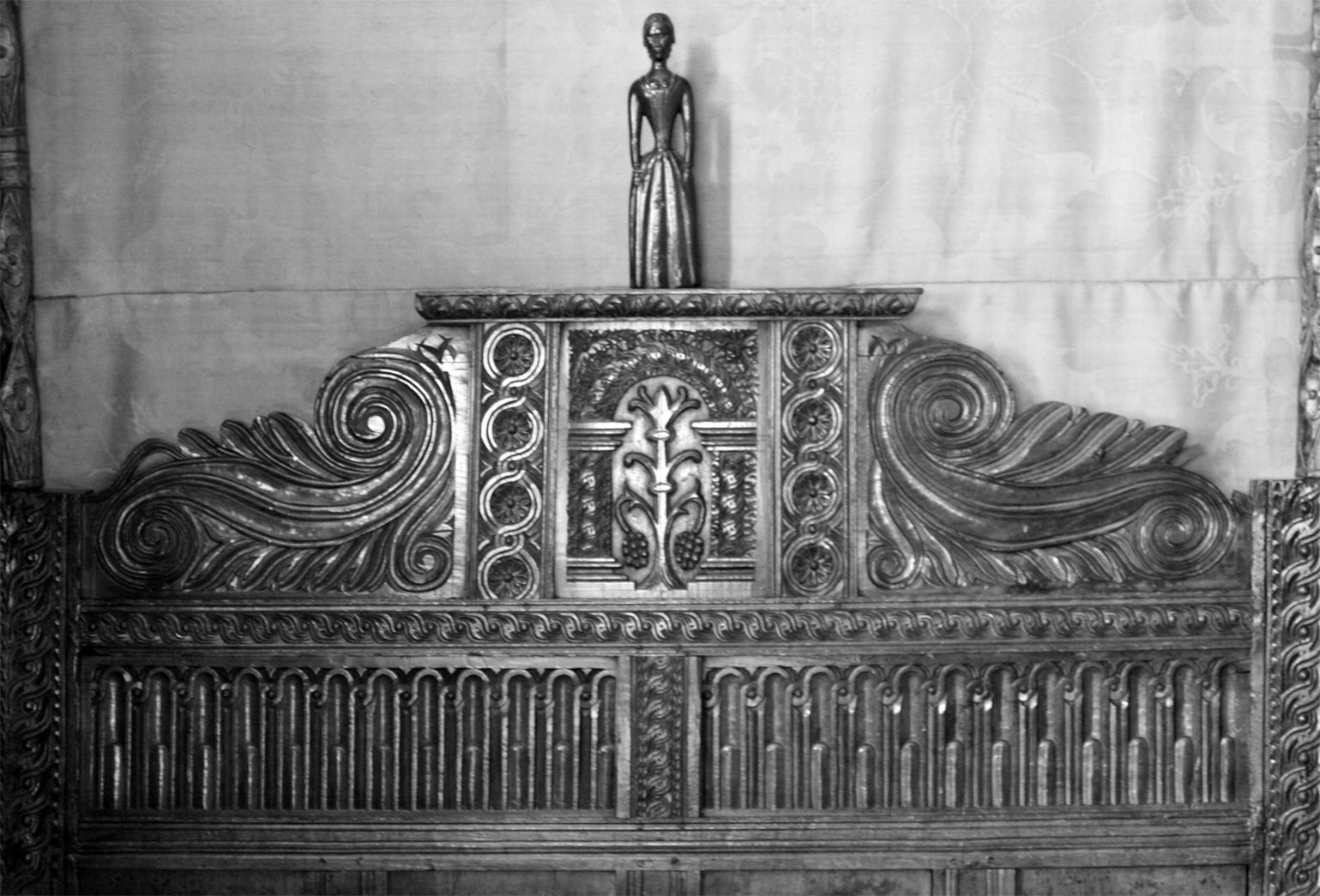
Cotehele is a Tudor manor house on the banks of the river Tamar, just over the border in Cornwall. It houses wonderful collections of oak furniture, arms and armour and tapestries inside its granite walls. Over the centuries it has been visited by Kings and Queens and more than one bed names a royal personage who has slept in it.

Carved oak headboard

Here is the original photo, before it was cropped, straightened and colour converted.
bed

Thanks to Issy for choosing me to take part, see her entries http://isadoraartandphotography.com/2015/02/15/5-day-bw-challenge-day-2/
Now, the challenge is to post a black and white image each day for five (I may take longer than five days to post five images) and to choose someone else to take part. For day one I’d like to choose Meg, she is currently on a long holiday in Poland and has lots of lovely photos to share taken in Warsaw. https://warsaw2015.wordpress.com/

Don’t panic if I pick you, relax and take part if you want to!

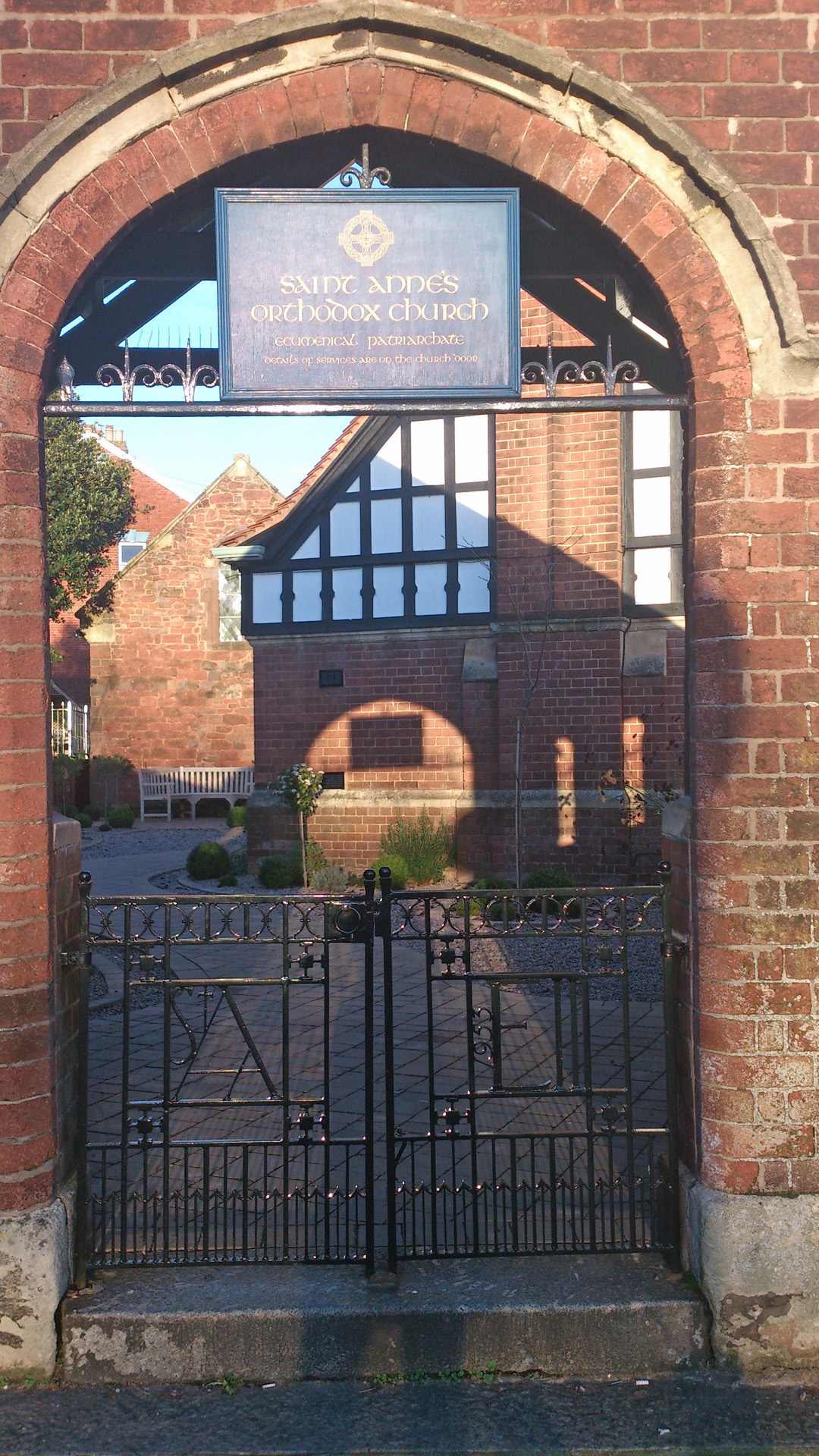
Angular St Annes

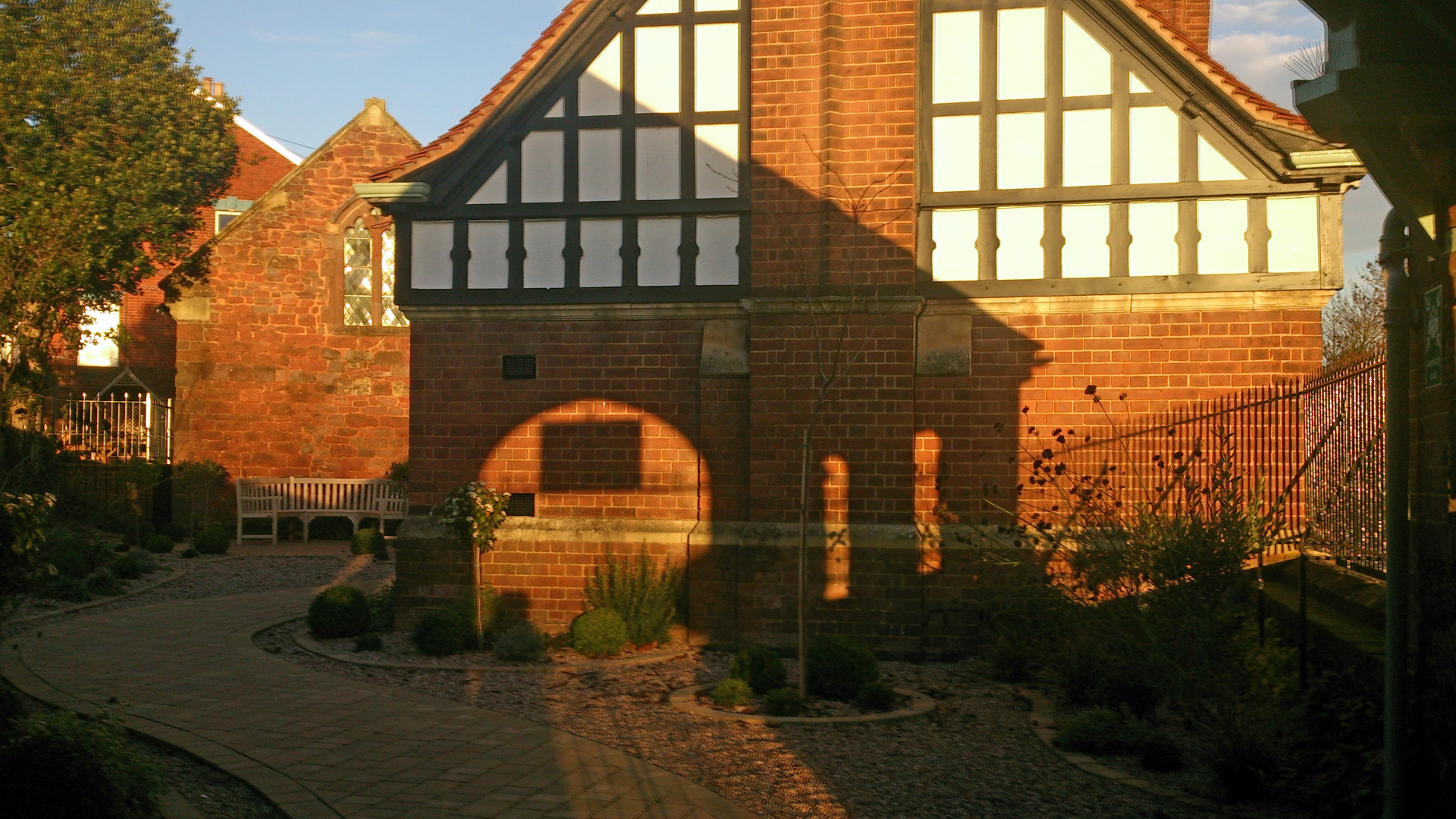
St Annes Chapel has stood on the edge of town for 596 years and I don’t know how many times I’ve walked past barely noticing it.  As a teenager, I even had to walk past daily to school, just around the corner. In recent years it’s been refurbished and although I didn’t go inside because I was dog walking, I could see that the courtyard looks lovely. The chapel is actually the building on the left as the back of the picture, while the white timbered buildings are alms houses.  Exeter was a prosperous town as far back as the 16th century, as the biggest city in Devon it was the centre of the county’s woollen trade. Hence the chapel was named St Annes, as she is the patron saint of weavers.

Like many of the oldest buildings in Exeter, the chapel and alms houses were built from red Heavitree  stone, quarried less than two miles away, close to where I grew up.  Today as I peeped through the gate the winter sun was bright and casting long shadows.

St Annes

That’s when I noticed the angular shapes all around the courtyard, even those shadows,

Angular St Annes

The chapel is now part of the orthodox Parish of the Holy Prophet Elias, and its website says that the parish belongs to the Archdiocese of Orthodox Parishes of Russian tradition in Western Europe under the Ecumenical Patriarchate.
This is my second entry for the photo challenge of ‘Angular’ over at http://dailypost.wordpress.com/dp_photo_challenge/angular/

Finding Gilbert Snow’s medal


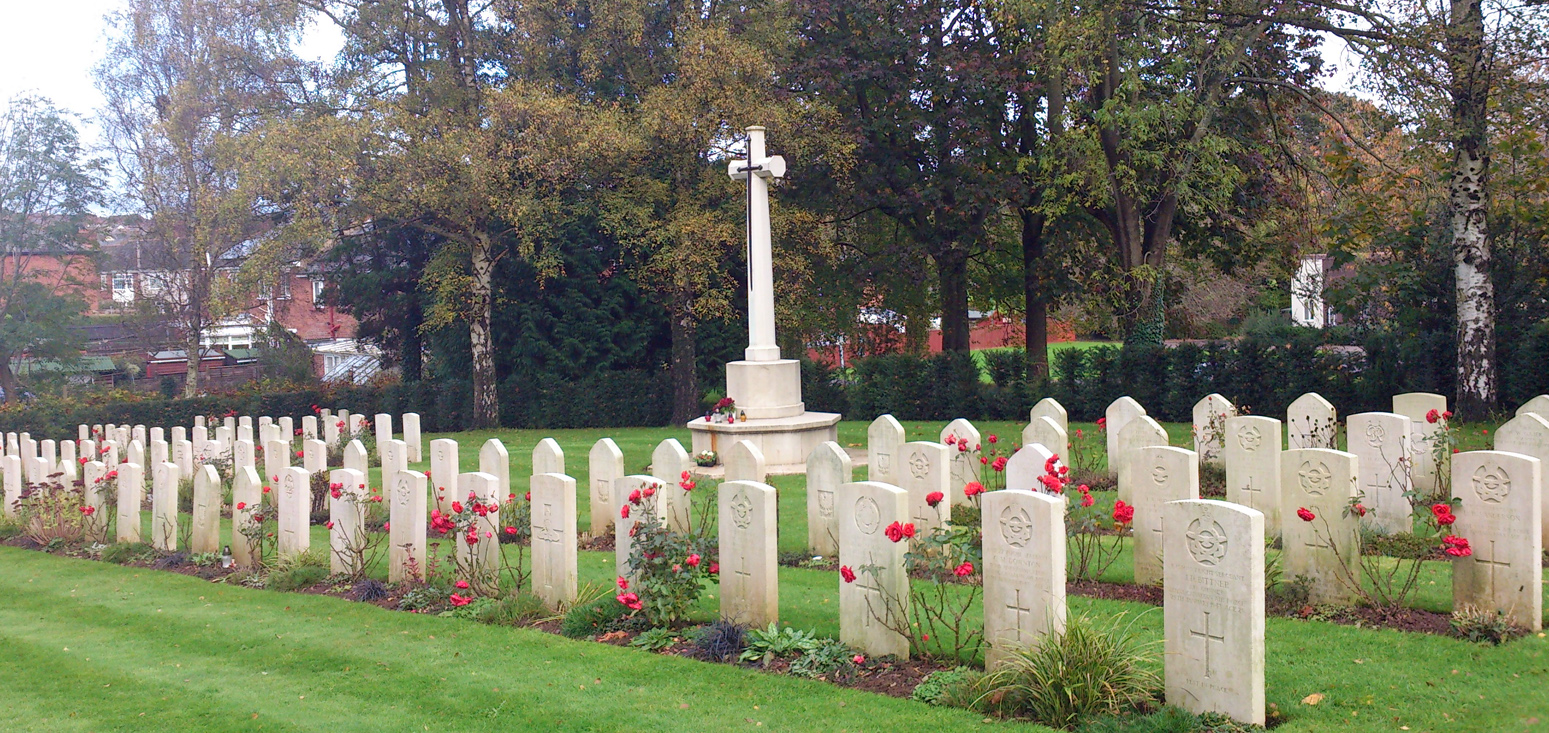
I walked the dogs  in the cemetery today and went by the war graves as I often do. There are still roses in bloom in the WW2 area.rem2
And the memorial for the local men lost in the first World War,
rem3
rem1

 
Then I went inside the little chapel where some local historians had set out some memorabilia

The best bit of all was meeting Terry Snow, a dear gentleman who was chatting to people about the war, to mark Remembrance Day this week. He was dressed in First World War uniform of 13th Middlesex Regiment, complete with rifle and bayonet.
Terry Snow
Terry’s father, Gilbert Snow was a Lewis Gunner who fought in the battle of Amiens, northern France in WW1, he was injured but he survived, passing away in 1972. His war medals were lost when his home was cleared and sold.
Earlier this year it was Mr Snow junior’s 75th birthday, an extra special one for him. After many years of searching antique shops and websites, on that very day, he found his father’s Victory Medal online and was able to purchase it. Today he wore it with great pride.
rem10
I felt very privileged, and emotional, when Terry told me this story, it’s one I shall remember each year on the second Sunday in November.

A Truck with a Past

In the 19th century, granite was quarried at Haytor on Dartmoor and was taken along a tramway  to the Stover Canal. From there it went by barge to Teignmouth, then by sea around Great Britain and further.  The tramway was opened on 1820, by George Templar of Stover, a long distance footpath , the Templar Way is named after him.

Granite from Haytor was used in the building of London Bridge, the British Museum and the National Gallery.

Trains of up to twelve trucks descended from Haytor, with a horse behind to slow them down.  Remains of the tramway can still be seen on Haytor Down. The ‘Relic’ of a truck below is similar to the ones used on the tramway. This post is for the Weekly Photo Challenge of Relic.

truck

Visit http://dailypost.wordpress.com/dp_photo_challenge/relic/

to join in.

WW Reveal

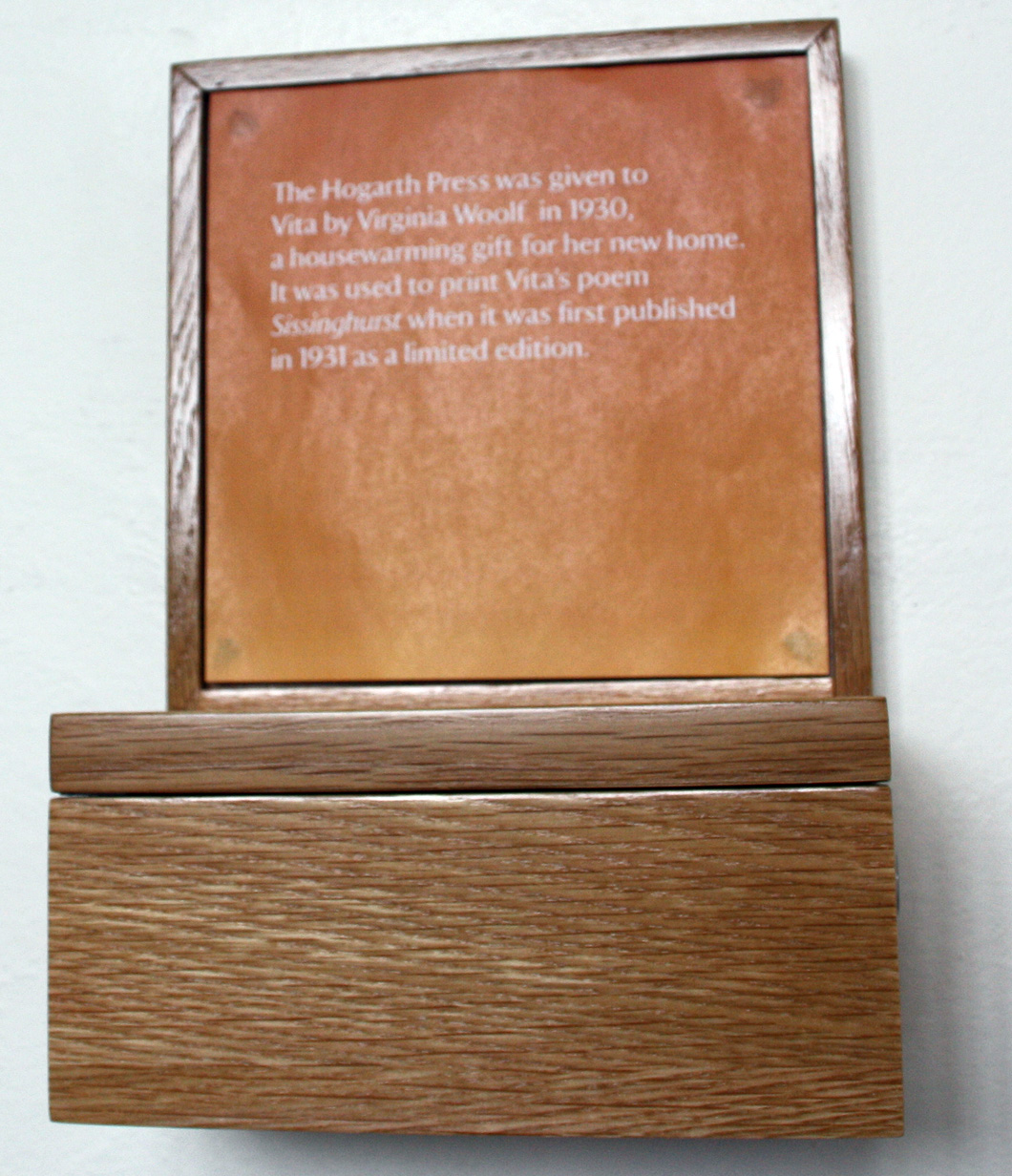
My Wordless Wednesday this week was an odd looking machine – but all machines are odd to me! For those wondering what it was, here’s the answer!

Hogarth press

The ‘Vita’, was Vita Sackville-West, an English writer, poet and gardener, best known for her affair with Virginia Wolfe and the wonderful garden she created at Sissinghurst, Kent.

Here is the opening section of the poem ‘Sissinghurst’ as in the photo above.

A tired swimmer in the waves of time

I throw my hands up: let the surface close:

Sink down through centuries to another clime,

And buried find the castle and the rose.

Buried in time and sleep,

So drowsy, overgrown.

That here the moss is green upon the stone.

And lichen stains the keep.

I’ve sunk into an image, water-drowned,

Where stirs no wind and penetrates no sound,

Illusive, fragile to a touch, remote,

Foundered within the well of years as deep

As in the waters of a stagnant moat.

Vita Sackville-West 1931


Agatha Christie, an American Connection

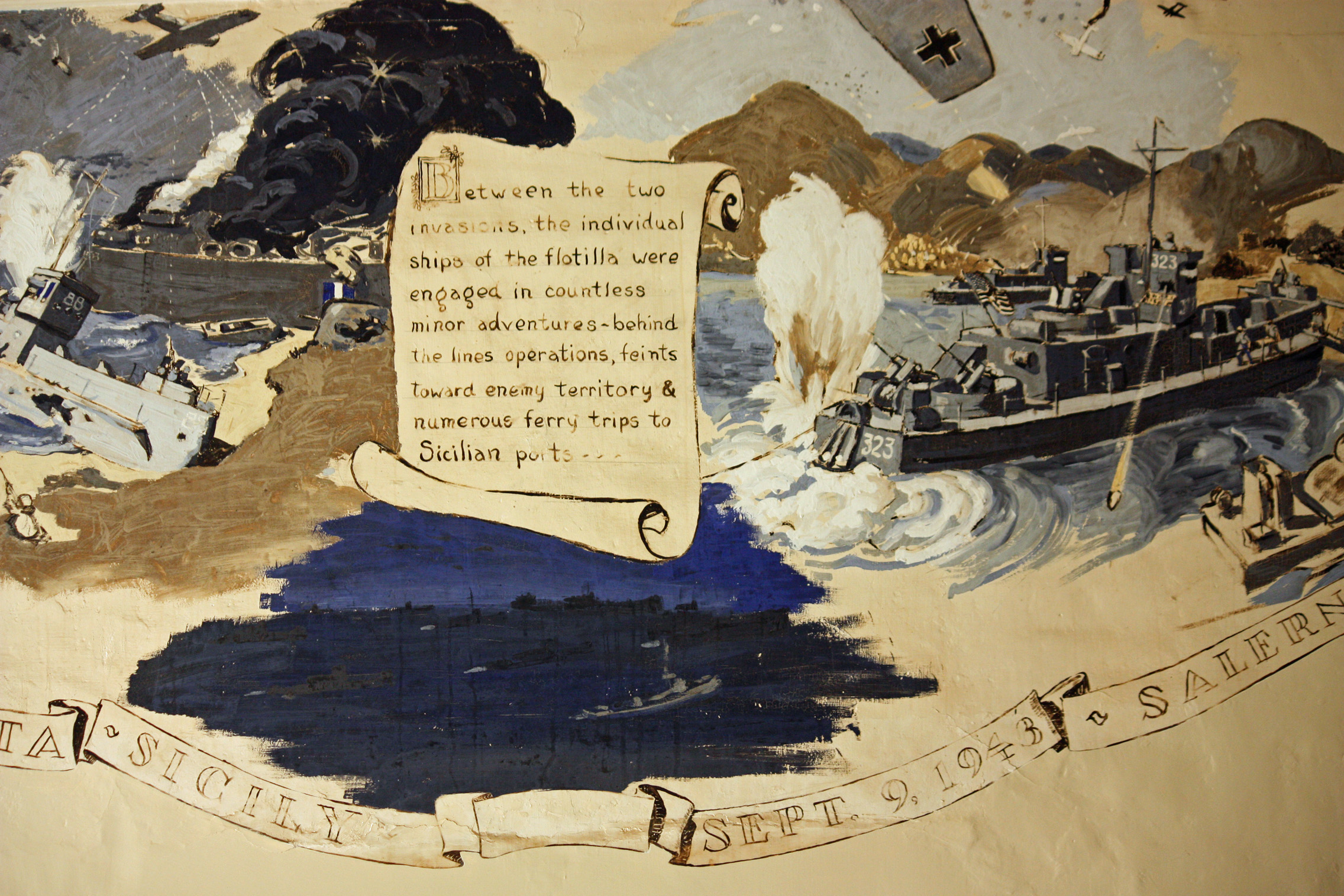
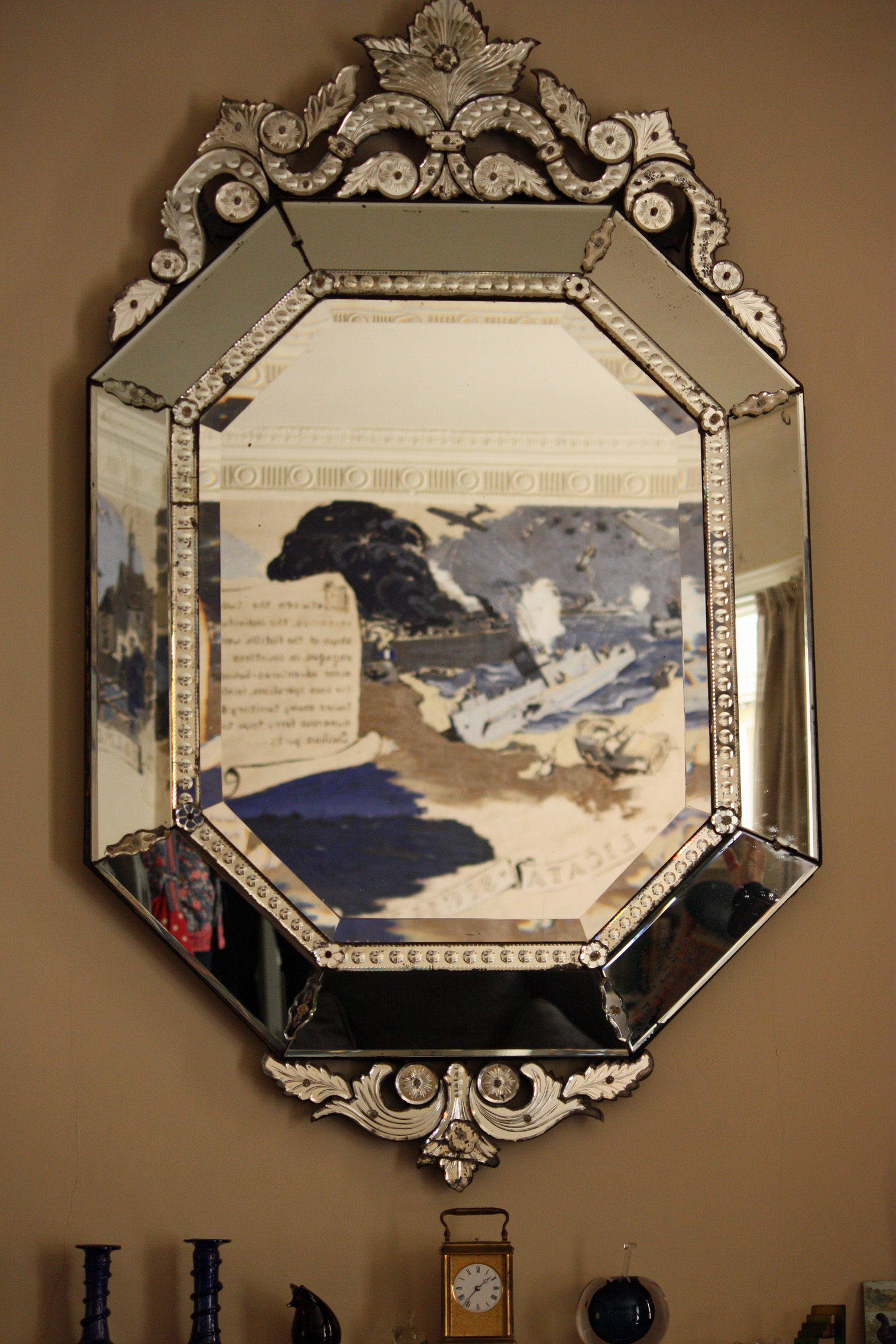
The volunteers at National Trust properties are a mine of information and very friendly. When I went into the library at Greenway I was immediately struck by a frieze/mural high on the walls, so I listened and joined in with another visitor asking the volunteer about it. Apparently the house was requisitioned by the army in WW2 and the painting was done by an American soldier.

a1

The mirror also has a tale behind it. There was a painting on the wall where it now hangs, of Churchill and Roosevelt together. When the war was over and the family were able to reclaim their home, they found the continuous gaze of the pair somewhat oppressive and painted over it!

a2

I’m sure the mural has been restored over the years, but I’d love to know who the soldier was and if he’s still around. Any ideas from my lovely American readers about how to find out?

Cotehele, in the details

Anyone who has been following my blog for while will know that I love to look at the small details of a place or subject, especially when I visit a historic house. Last weekend at Cotehele was a real feast for my eye, so I thought I would share with you. I hope you enjoy this little gallery, click for a larger view and let me know which is your favourite!

The Great Hall at Cotehele

Cotehele is a Tudor manor house built between 1485 and 1539, high above the banks of the river Tamar in Cornwall. It was owned by the same family- the Edgcumbes,for six hundred years and is one of the best preserved Medieval manors in the country. They rebuilt the original 13th century property, before creating an even grander home a few miles away at Mount Edgcumbe, so Cotehele was little used and hardly changed over the centuries. The house became National Trust property in 1947 in lieu of death duty.
Today I’m showing you some of the armoury to be fond in the Great Hall.

And some other items I liked.

I’ll be back in a few days with some more photos of the house and garden.

Looking Through the Squint

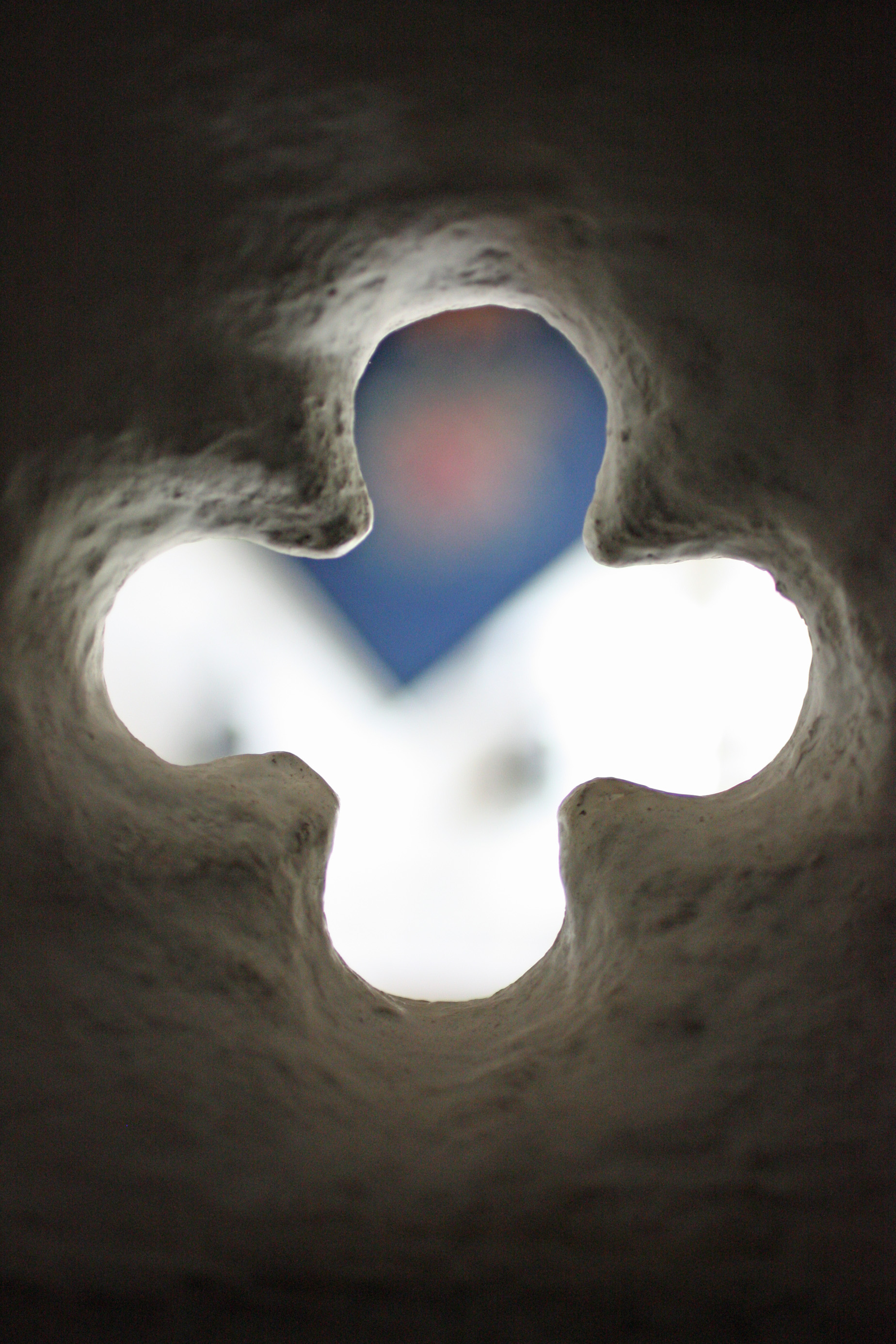
I’ve had a really lovely weekend, full of creativity and sunshine. Yesterday I went to a National Trust property just over the border in Kernow – Cornwall. They say that Cotehele probably originated around 1300 but most of the building took place in the late 15th century. I’ll post some more photos later but meanwhile here’s a little squint. A squint is a small peephole built into a wall, so that that owner could look down on other rooms to check what people were up to, they were often added in mediaeval times. At Cotehele this on looks down on the Great Hall.

sq1
sq2
sq3

A la Ronde

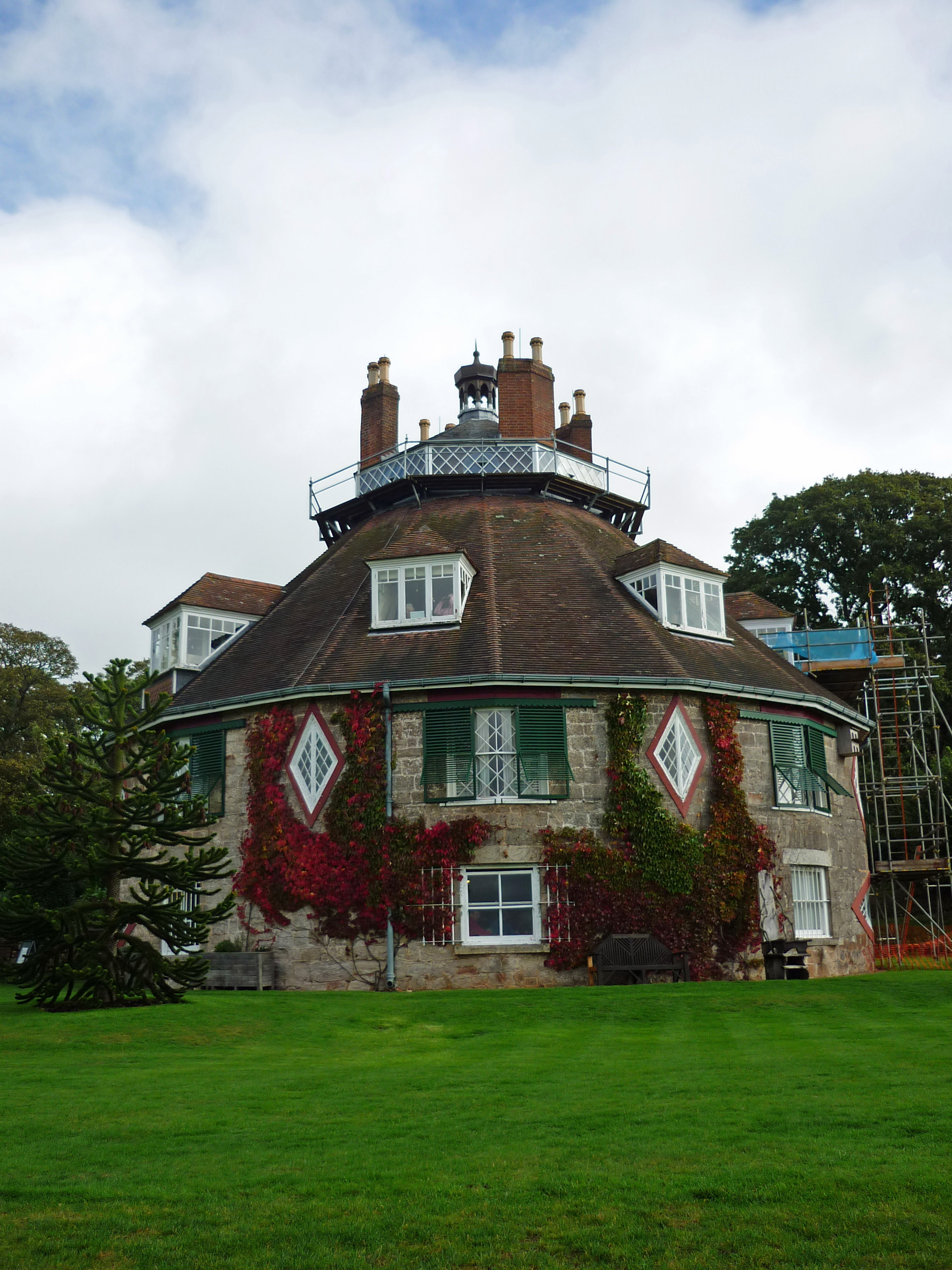
Just a few miles south east of Exeter is the National Trust property, A la Ronde. The house was built in the 1790’s by  Jane and Mary Parminter. The two ladies , cousins, had a real sprit of adventure, and I’m sure if they were alive today they would be trekking the Sahara or leading expeditions to the polar regions.

They lived at A la Ronde for fifty years, filling it with things they had collected on their Grand Tour.

Although the name implies that the house is round , it actually has sixteen sides, it’s unique design takes advantage of natural light as the sun moves around through the day. The lower level that you see above is used as the restaurant by the National Trust,  the diamond shaped windows are the ground floor. At the centre of the house is an area that rises to the top floor gallery with doors all around it.

alar12

It’s really difficult to take photos inside, flash is not allowed, and I’m too lazy to use a tripod. The answer is a very wide angle lens, patience with many other visitors and a steady hand. But here are a few interior shots.

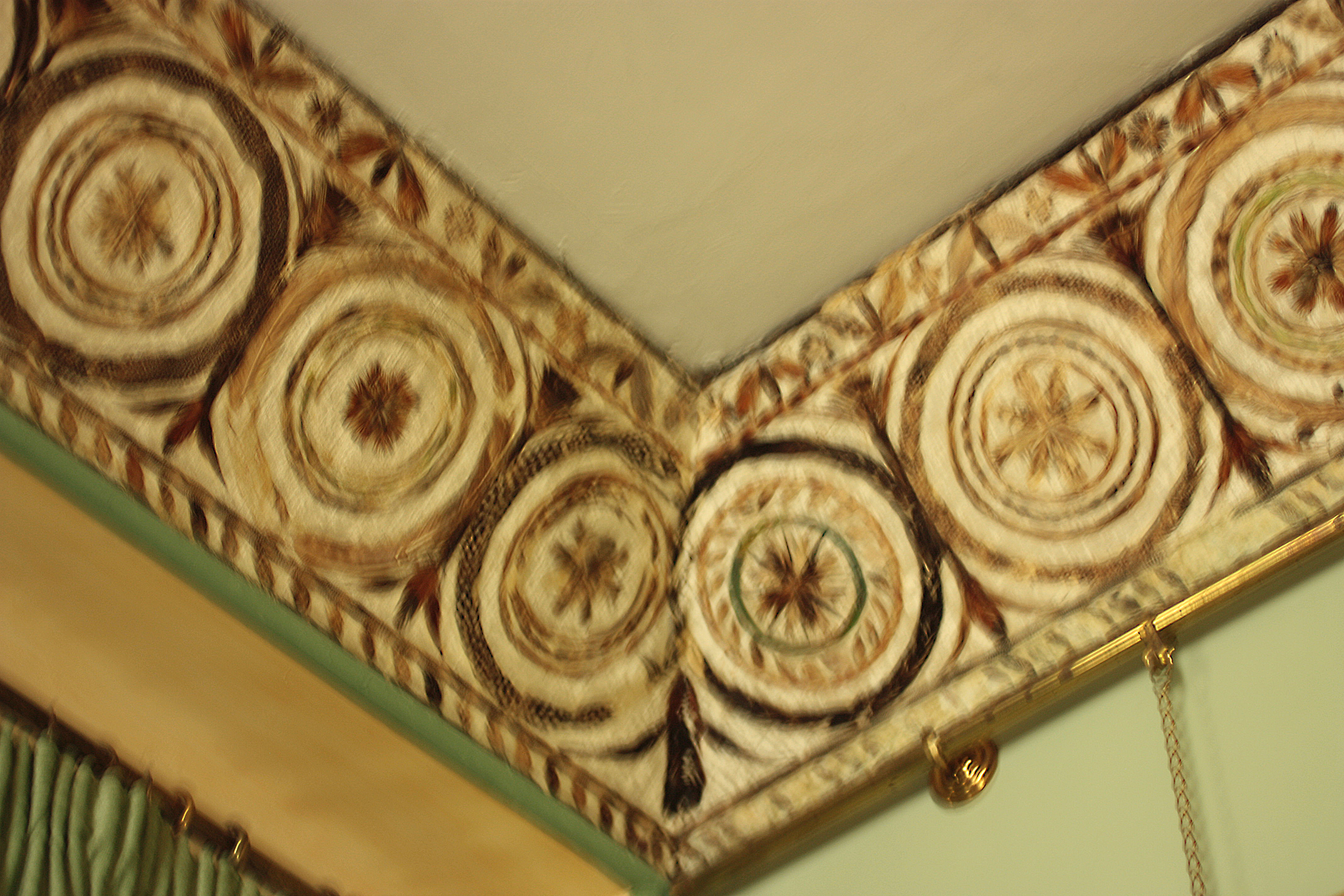
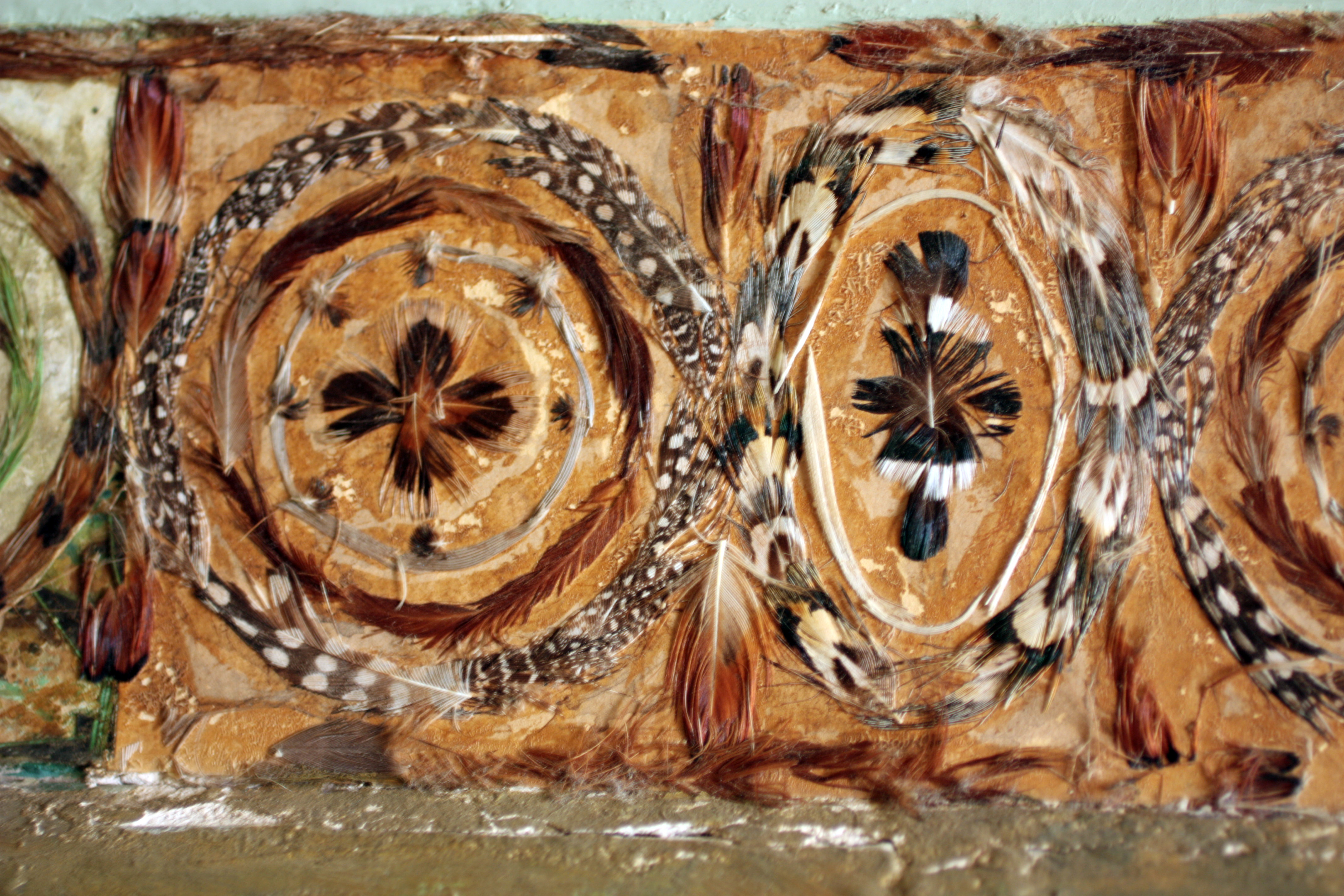
The ladies had several passions that filled their days, embroidery, shells and feathers to name just a few. The drawing room has been hand decorated by them with a feather frieze all around the room.

alar13

The feathers come from chickens, game birds and even parrots and have been applied with isinglass. alar14

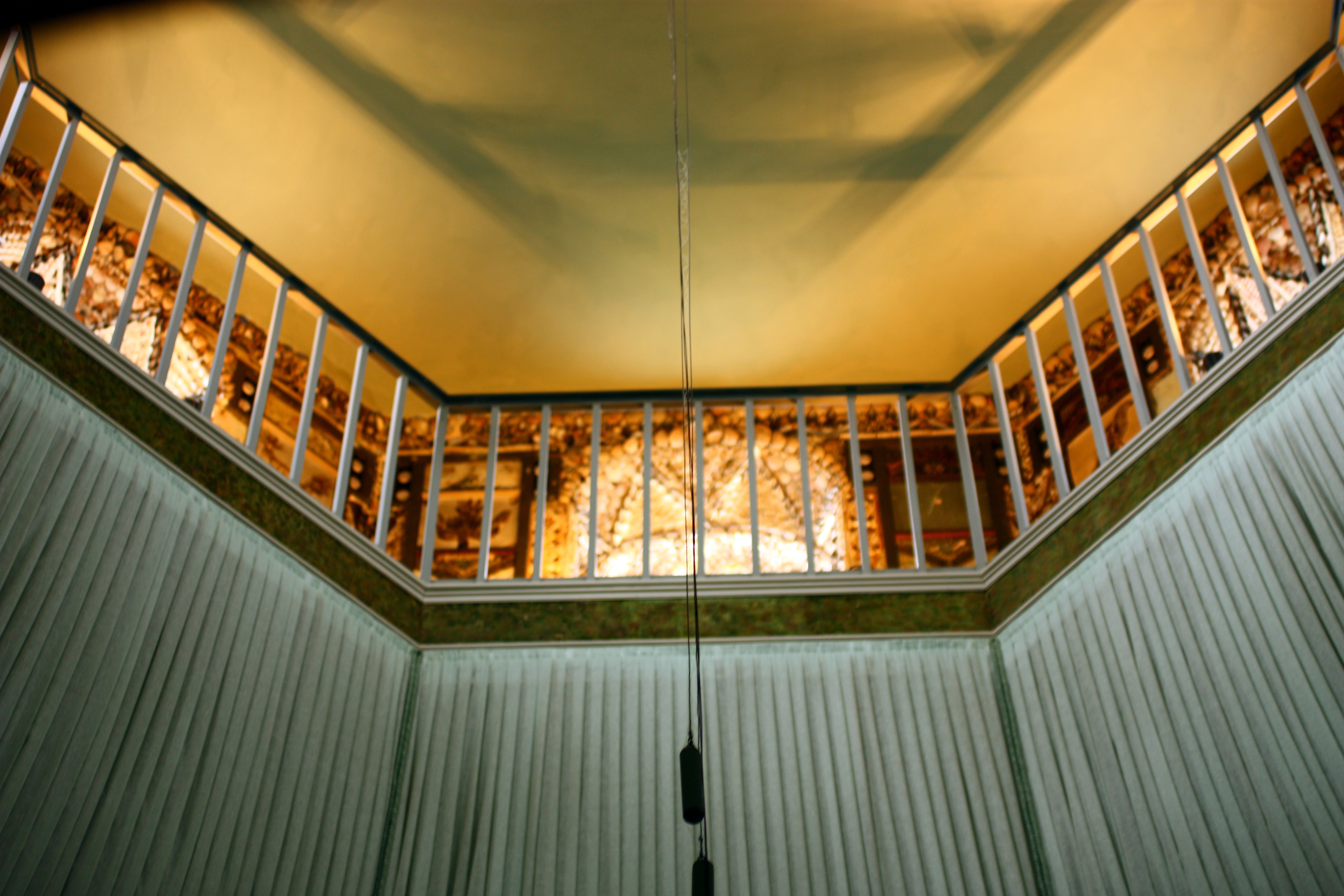
When I last went to A la Ronde thirty years ago, it was a private group visit and I didn’t really appreciate it. I did get to see the highlight of the house, the famous shell gallery. It’s closed now to preserve it for the future. With the help of  well placed mirrors, you can get a tiny peep at it from the floor below, and this is my shot from the central room on the ground floor. gallery

I asked one of the volunteers if she had been allowed up there and even they aren’t. So the photos below are of photos on display so that visitors can get an idea what it’s like. What is it like? beautiful, bizarre, indescribable. To think that these women spent probably years creating this.

This slideshow requires JavaScript.

So that’s A la Ronde, maybe one day you’ll visit if you’re in Devon, I promise you it’s like nowhere else anywhere!

My earlier post of the outside of the house, https://lucidgypsy.wordpress.com/2013/11/19/red-bricks-and-funky-windows-the-charm-of-a-la-ronde/